Search


Bond Credit Rating: Meaning, Rating Scale (AAA to D) and How Bonds Are Rated
 20.16K

Key Takeaways
- Bond credit ratings help investors understand the credit risk involved in a bond investment.
- Ratings are assigned by credit rating agencies after reviewing the issuer’s financial condition and repayment ability.
- AAA is the highest long-term credit rating, while D indicates default or expected default.
- Short-term debt instruments use a different rating scale, ranging from A1+ to D.
- Symbols such as + and – show the relative position of a rating within a category.
- Credit ratings can change when an issuer’s financial condition changes.
- Investors should check the latest credit rating, rating outlook and other bond details before investing.
What are Bond Ratings?
An applicant’s credit score is a primary factor a lender considers when considering a loan application. A higher credit score increases the likelihood of loan approval.
Similarly, bond ratings are a great way to identify a bond issuer’s creditworthiness. It shows whether the issuer can comply with the bond contract’s terms. In other words, whether the bond issuer can pay back the principal and interest amount on due dates.
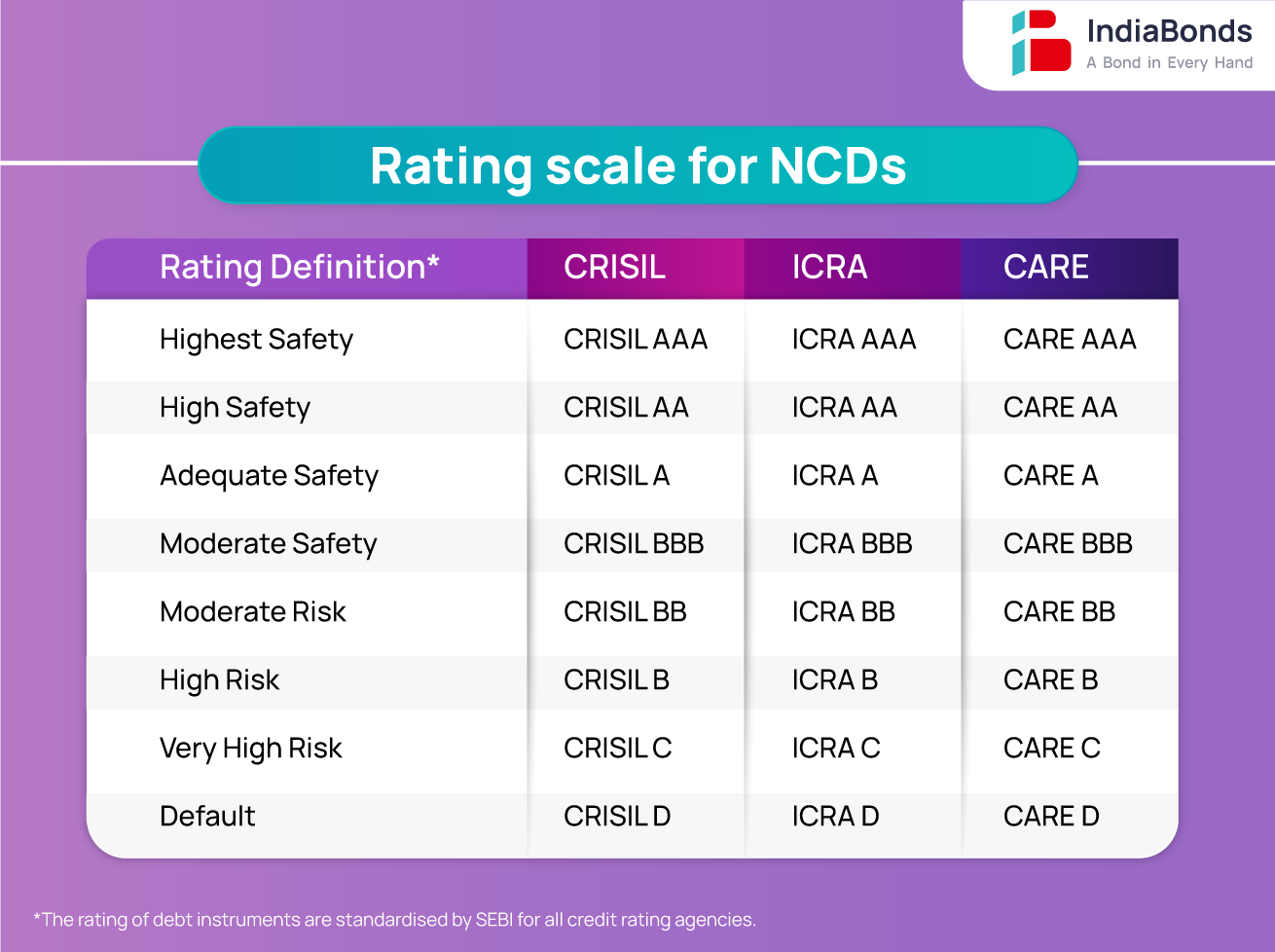
The higher the bond credit rating, the better the issuer’s financial strength. A bond rating ranges from AAA to D, with AAA being the highest and D being the lowest denoting default by the issuer. CRISIL, Care, and ICRA are three major credit agencies that issue these credit ratings to the bonds in India.




Bond Credit Rating Scale
Short-Term Rating Scale (A1+ to D)
Short-term credit ratings are used for debt instruments with an original maturity of up to one year, such as commercial papers. These ratings help investors understand the issuer’s ability to repay short-term financial obligations.
The table below explains the short-term credit rating scale used in India.
| Credit Rating | Meaning | Credit Risk |
|---|---|---|
| A1+ | Highest rating within the A1 category, indicating very strong repayment ability. | Lowest |
| A1 | Very strong ability to meet short-term financial obligations. | Lowest |
| A2+ | Strong repayment ability, with a higher position within the A2 category. | Low |
| A2 | Strong ability to repay short-term obligations on time. | Low |
| A3+ | Moderate repayment safety, with a higher position within the A3 category. | Moderate |
| A3 | Moderate ability to meet financial obligations, with higher risk than A1 and A2. | Moderate |
| A4+ | Limited repayment safety, but a higher position within the A4 category. | Very High |
| A4 | Minimal repayment safety and greater possibility of default. | Very High |
| D | The instrument is in default or expected to default on maturity. | Default |
Note: The + symbol indicates a higher position within the same short-term rating category. Short-term ratings do not use the minus (-) modifier.
What +, -, Outlook and Rating Watch Mean
Credit ratings may include additional symbols or terms that provide more information about an issuer’s financial position. Understanding these terms can help investors read bond ratings more accurately.
- Plus (+): Indicates a relatively stronger position within a rating category. For example, AA+ is higher than AA.
- Minus (-): Indicates a relatively lower position within a rating category. For example, AA- is lower than AA but higher than A+.
- Stable Outlook: Suggests that the credit rating is unlikely to change significantly in the near to medium term.
- Positive Outlook: Indicates that the credit rating may improve in the future.
- Negative Outlook: Indicates that the credit rating may be downgraded in the future.
- Rating Watch: Means the rating agency is reviewing the possible impact of a specific event on the issuer’s creditworthiness. It may have positive, negative or developing implications.
An outlook or rating watch does not mean the rating will definitely change. Investors should check the latest rating report for more details.
How Are Bonds Rated? The Rating Process
Credit rating agencies evaluate a company’s financial strength and ability to repay its debt before assigning a bond rating. They study the company’s financial performance, existing borrowings, business operations and other factors that may affect repayment. The rating helps investors understand the credit risk associated with the bond.
The rating process generally involves the following steps:
- Information Collection: The rating agency collects financial statements, debt details and other important information from the issuer.
- Financial Analysis: The agency reviews the company’s revenue, profitability, cash flow and existing debt obligations.
- Business Evaluation: The agency studies the company’s industry position, business risks and management.
- Rating Assignment: A rating committee reviews the findings and assigns a credit rating based on the issuer’s repayment ability.
- Rating Publication: The agency publishes the credit rating along with a report explaining the reasons behind it.
- Regular Monitoring: The rating agency continues to review the bond during its tenure and may revise the rating if required.
A credit rating is an assessment of repayment risk and does not guarantee that the issuer will meet its obligations.
Factors That Affect a Bond’s Credit Rating
A bond’s credit rating depends on the financial strength of the issuer and its ability to repay the borrowed amount on time. Credit rating agencies study several factors before assigning or changing a rating. These factors help investors understand the credit risk involved in a bond.
- Financial Performance: The company’s revenue, profits and overall financial condition affect its credit rating.
- Debt Levels: Companies with high debt may face greater repayment pressure, which can affect their ratings.
- Cash Flow: A company with steady cash flow is generally better positioned to make interest and principal payments on time.
- Business Performance: The company’s market position, business growth and industry conditions can influence its rating.
- Management Quality: Strong management and responsible financial decisions can support a company’s creditworthiness.
- Economic Conditions: Changes in interest rates, inflation and overall economic conditions may affect the issuer’s repayment ability.
- Repayment History: A company’s record of paying interest and repaying loans on time is an important factor in assessing credit risk.
Credit ratings may change over time as these factors change. Investors should check the latest rating and the issuer’s financial condition before investing in a bond.
Credit agencies issue bond ratings after considering multiple factors. Listed below are some metrics which go to explain how bonds are rated.
1. Strength of Issuer’s Balance Sheet
Balance sheets and cash flow statements show how quickly an issuer pays off its debts and uses its cash. A lower debt liability means better liquidity and financial position, and thus, the better the bond rating.
2. Vulnerability to Economic Conditions
Companies cannot avoid the political and economic conditions of the country. However, you can analyze its vulnerability to these conditions. The company’s bond rating is determined by its vulnerability to adverse political conditions. The higher the company’s vulnerability, the lower the bond rating.
3. Outlook for the Industry
Credit rating for bonds is also significantly affected by the state of the industry they are in. If the industry overall sees an uptick in terms of revenue and profits, the credit ratings are bound to improve. However, if the opposite were to occur and an industry were to be in a downturn, the credit ratings may worsen.
4. Growth Projections of the Company
A company’s growth projections affect the status of potential investments. A company with high growth projections is more likely to attract investments. As such, the better the growth projections of the company, the better the bond credit rating.
5. Creditworthiness
Purchasing a company bond makes you the company’s creditor. Therefore, the company is responsible for paying the principal and interest on time. If they default, the bond rating will be affected.
Credit Rating Agencies in India
Credit rating agencies in India assess the creditworthiness of companies and debt instruments. They are regulated by the Securities and Exchange Board of India (SEBI). Some well-known credit rating agencies include CRISIL Ratings, ICRA, CARE Ratings, India Ratings and Research, Acuité Ratings and Research, and Infomerics. These agencies examine financial information and assign ratings that help investors understand the credit risk of different bonds.
Importance of Credit Ratings
Credit ratings are vital as they provide investors with a measure of the risk associated with investing in a bond. They are indicative of the likelihood that the issuer will be able to meet its financial obligations. By understanding the bond credit ratings explained, investors can make more informed decisions and better assess the risk-return profile of their investments.
Investment Grade and High Yield Bonds
Depending on the credit agency ratings, you can classify the bonds into investment-grade and non-investment-grade bonds.
An investment grade bond, rated between AAA and BBB, is considered to be a safer and more stable investment.
Conversely, Non-investment-grade or high-yield bonds carry a higher degree of risk, which is why they have lower credit ratings, such as BB+ to D. Since these bonds carry additional risk, they come with high yields. Usually, small businesses, startups, or companies with weaker competitive positions or lack operational diversification receive these bond ratings.
Credit agencies periodically evaluate the bond ratings. If an investment grade loses its credit quality, it moves to a non-investment grade rating. Then, it is also known as fallen angel bonds.
When Ratings Change: What Should You Do?
Bond ratings are not fixed for life. They can be upgraded or downgraded depending on how the issuing company’s financials and business outlook evolve. For an investor, a rating change is a signal to reassess the position. A downgrade may indicate rising risk, which could impact bond prices and even the ability of the issuer to repay on time. On the other hand, an upgrade can improve liquidity and potentially enhance market value. The best approach is not to panic but to evaluate the broader context—consider whether the rating change is due to temporary challenges or long-term structural issues. Staying updated with rating revisions and linking them to your investment goals helps in making timely and informed decisions.
Bond Ratings and Returns and Risks
There is a direct relationship between credit ratings, returns, and risks. Bonds with higher ratings (AAA, AA) are considered safer, but they generally offer lower yields since the probability of default is minimal. Conversely, lower-rated bonds compensate investors with higher returns, but this comes with a greater risk of non-payment. Investors must strike a balance between the appetite for safety and the hunger for returns. For example, conservative investors may prefer investment-grade bonds for steady income, while those willing to shoulder more risk could consider high-yield bonds. Understanding this trade-off is crucial because the rating is not just a letter—it translates into the actual financial experience of risk and reward.
Advantages And Limitations of Credit Ratings
Credit ratings simplify complex financial information into easy-to-read symbols, making them a useful starting point for investment decisions. They offer transparency, help assess default risk, and enable investors to compare issuers across industries. However, credit ratings are not foolproof. They rely on the accuracy of available data and the judgment of rating agencies, which may not always capture sudden changes in a company’s situation. Ratings also reflect relative risk, not absolute safety—meaning even highly rated bonds can face stress under extreme circumstances. For investors, ratings should be seen as one of many tools. Combining them with personal research, market updates, and professional advice ensures a more rounded and safer approach to bond investing.
How to Check a Bond’s Credit Rating on IndiaBonds
Investors can check the credit ratings of bonds listed on IndiaBonds before making an investment decision. Here are the steps:
Step 1: Visit IndiaBonds
Go to www.indiabonds.com and open the bond investment section.
Step 2: Search for a Bond
Search for a bond using the issuer’s name or ISIN, or browse the available bonds.
Step 3: Use the Credit Rating Filter
Select the preferred credit rating category, such as AAA, AA or A, to narrow down the available options.
Step 4: Check the Bond Details
Open the selected bond and review its displayed credit rating, maturity date, Yield to Maturity (YTM) and other important details.
Step 5: Verify the Latest Rating
Check the rating agency’s latest rating rationale and any recent rating changes before investing.
Investors should also compare the bond’s credit rating with its returns, maturity period and liquidity before making a decision.
In a Nutshell
Bond credit ratings are a basic and easy way to verify the quality and stability of the bond. As part of the primary checks before investing, check the bond rating to understand the issuer’s creditworthiness. However, it is important to remember that it’s one of the key parameters to consider while investing but not the only parameter.
Verify bond credit ratings for any bond by browsing through IndiaBonds’ Bond Directory, where you can access detailed bond information. Happy Investing!
FAQs
Q. What is the best credit rating for bonds?
A. The best credit rating for bonds is ‘AAA’, signifying the highest level of creditworthiness and the lowest risk of default.
Q. What is the credit score of a bond?
A. The credit score of a bond is a rating or grade given to a bond issuer by a credit rating agency. This score indicates the likelihood that the issuer will be able to repay their debt obligations. A higher rating suggests a lower risk of default, thereby implying that the issuer is more likely to meet its financial commitments on time and in full.
Which is a better bond rating, AAA or BBB?
AAA is higher than BBB and indicates the lowest credit risk. BBB-rated bonds carry moderate credit risk and may offer higher yields, but they also involve greater repayment risk.
Which rating is better, AA+ or AAA?
AAA is higher than AA+ and represents the highest degree of safety regarding timely repayment. AA+ also indicates strong creditworthiness but carries relatively higher credit risk.
Which are AAA-rated bonds in India?
Examples include certain bonds issued by NABARD, REC Limited, Power Finance Corporation (PFC) and Reliance Industries. The rating depends on the specific bond and may change over time.
Is a BBB-rated bond safe?
BBB-rated bonds fall within the investment-grade category but carry moderate credit risk. They are not risk-free. Investors should check the issuer’s financial condition, rating outlook and repayment ability before investing.
Disclaimer : Fixed returns do not constitute guaranteed or assured returns. Investments in corporate debt securities, municipal debt securities/securitised debt instruments are subject to credit risks, market risks and default risks including delay and/or default in payment. Read all the offer related documents carefully.
20.16K

MAHAVEER FINANCE (INDIA) LIMITED

SHRI RAM FINANCE CORPORATION PRIVATE LIMITED

SPANDANA SPHOORTY FINANCIAL LIMITED

FINNABLE CREDIT PRIVATE LIMITED

NAMRA FINANCE LIMITED

SHIVALIK SMALL FINANCE BANK LIMITED
NAMRA FINANCE LIMITED

UTKARSH SMALL FINANCE BANK LIMITED