Search


How the Bonds Partner Program Works: A Complete Guide
 1.50K
1.50K
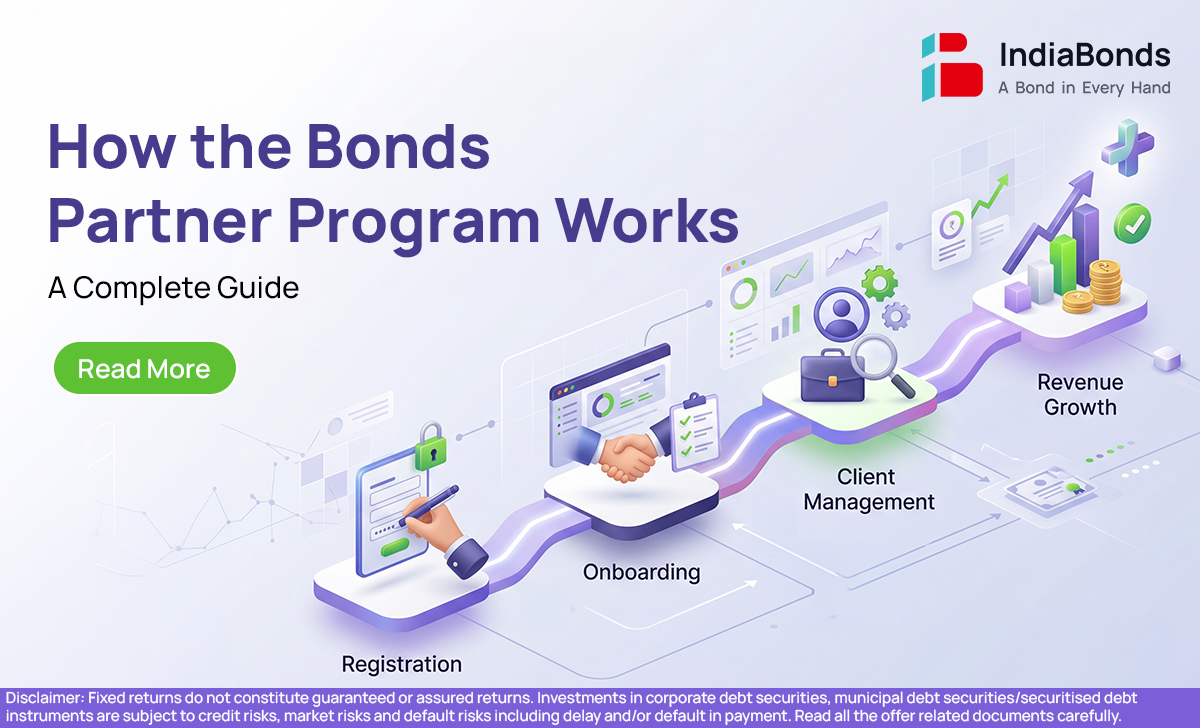
A step-by-step guide explaining how the Bonds Partner Program operates — from registration and onboarding to client investment management and revenue earning — tailored for financial professionals ready to build a structured fixed income distribution practice.
Fixed income is no longer a side conversation for most financial professionals. Investors are asking about bonds, regular income, portfolio diversification, and alternatives to traditional fixed deposits and market-linked products. At the same time, advisors and distributors know that offering bonds is not as simple as naming a product. Clients ask about yield, coupon structure, maturity, issuer profile, credit rating, liquidity, taxation, and the mechanics of investing.
Managing all of this manually — across multiple clients with different timelines and risk appetites — becomes difficult. This is exactly where the IndiaBonds Fixed Income Channel Partner Program becomes useful.
This guide explains how bonds partner program works in a clear, practical way — covering every step from registration to revenue earning.
Overview: How the IndiaBonds Partner Program Works
To understand how the IndiaBonds partner program works, it helps to look at the complete journey. A partner registers on the IndiaBonds platform, completes onboarding, gains access to the partner dashboard, refers or manages clients, tracks their bond investments, and earns revenue when eligible transactions are completed.
The working of bonds partner program is built on a clear division of responsibility. IndiaBonds provides the technology, bond access, regulatory infrastructure, digital execution support, and platform operations. The partner brings client relationships, financial expertise, and investor communication. Together, this creates a more efficient route for clients to access fixed income products.
In simple terms, how bonds partner program works can be mapped across five stages: registration, onboarding and dashboard setup, client investment management, revenue earning, and ongoing partner support. Each stage is designed to make the partner’s work easier — not more complicated.
For a Fixed Income Channel Partner, this model removes the most significant operational barriers to fixed income distribution. Instead of building a separate bond desk or managing clients through fragmented spreadsheets and manual follow-ups, partners can operate through a single organised platform. This frees time and mental bandwidth for what matters most: client education, relationship building, and portfolio conversations.
Understanding how bonds partner program works fully means looking at each step in sequence — which is what this guide does.
Step 1: Registering as an IndiaBonds Partner
The first step in how indiabonds partner program works step by step is registration. A financial professional, distributor, or eligible business can visit the IndiaBonds partner portal at partner.indiabonds.com and begin the sign-up process.
During registration, the applicant provides basic details including name, mobile number, email ID, city, business category, and professional background. For entity applicants — companies, LLPs, partnership firms, fintech platforms, or NBFCs — additional business details may be required. These details help IndiaBonds understand the partner’s background, client network, and intended business model.
Registration might appear straightforward, but it sets the foundation for everything that follows. Fixed income distribution depends on trust and compliance. Clients rely on financial professionals to explain regulated products responsibly. This means partner registration includes proper verification, documentation, and profile review — not just a basic form submission.
What documents are needed to register as an IndiaBonds partner?
The exact document list may depend on partner type and onboarding requirements. Partners should generally keep identity documents, PAN details, business registration proofs, bank account information, and payout-related documents ready before beginning. Having these prepared in advance helps avoid delays in the registration and approval process.
The program is open to mutual fund distributors, insurance distributors, independent financial advisors, wealth professionals, chartered accountants, finance consultants, fintech platforms, and firms with investor networks. A person does not need to be a bond market specialist from the start — but they should be ready to understand fixed income products before discussing them with clients.
Once registration is submitted, IndiaBonds reviews the information and moves the partner to the onboarding stage after approval.
Step 2: Onboarding and Partner Dashboard Setup
The second stage in how indiabonds partner process works is onboarding and dashboard access. After approval, the partner is integrated into the IndiaBonds ecosystem and given access to the partner dashboard — the central tool for managing their fixed income business.
The partner dashboard is where the operational value of the program becomes visible. Through it, partners can view available bond opportunities, track client sign-up and KYC status, monitor transaction activity, and review business performance metrics — all within a single organised interface.
For a Fixed Income Channel Partner managing multiple clients at different stages of the investment journey, this centralised visibility makes a meaningful difference. One client may be comparing yields across issuers. Another may be waiting for a bond maturity to reinvest. A third may need help understanding the coupon payment cycle. The dashboard supports all of these threads without requiring manual tracking across separate documents or messages.
The onboarding stage typically includes guidance from the IndiaBonds partner support team. Partners are walked through the dashboard, introduced to available bond inventory, shown how to refer clients and track their progress, and oriented to the follow-up process for pending transactions. Onboarding is not just about access — it is about making the partner genuinely ready to serve clients through the platform.
Step 3: Managing Client Bond Investments as a Partner
Once onboarding is complete, the partner can begin managing client bond investments through the IndiaBonds platform. This is where how bonds partner program works becomes real in the context of everyday business.
Partners can introduce clients to bond opportunities based on individual investment objectives — income expectations, time horizon, risk understanding, and portfolio composition. Some clients may prioritise regular interest income. Others may want maturity-based certainty or diversification away from equity-linked products. The platform’s bond inventory provides options across these needs.
The partner’s role here is substantive, not transactional. A client looking only at yield numbers needs a partner who can explain the complete picture: issuer profile, coupon structure, maturity date, credit rating, payment frequency, liquidity characteristics, and relevant risk factors. Two bonds that appear similar on yield may differ significantly on issuer quality, maturity, rating, or secondary market liquidity — and it is the partner’s responsibility to surface these differences.
IndiaBonds supports this process by providing partners with digital tools and platform access so clients can explore, compare, and invest in bonds with more clarity. The partner remains involved through the transaction and beyond.
Post-investment servicing is an important and often underestimated dimension of bond distribution. Clients ask when interest will be paid, how maturity proceeds are handled, whether reinvestment is possible, and how the bond fits the broader portfolio. These are recurring questions — not one-time concerns. A partner who answers them consistently builds stronger client trust and a more durable practice.
Step 4: Revenue Sharing and Payouts — How Partners Get Paid
Revenue is a central reason financial professionals explore the IndiaBonds partner program — and how bonds partner program works in terms of earnings is clearly defined.
Partners can earn revenue when referred or managed clients complete eligible bond transactions through the platform. The exact commission, brokerage, or revenue share structure depends on the product type, transaction category (public issue versus secondary market), issuer terms, and applicable program agreement. Partners should always verify the current payout structure directly with IndiaBonds before communicating specific earning expectations to others.
The revenue process flows logically: a partner onboards a client, the client completes an eligible transaction, and once all conditions are satisfied, the partner’s earnings are calculated and processed within the applicable payout cycle.
Trail-based commissions are particularly valuable for Fixed Income Channel Partners building a long-term book. Trail revenue is linked to AUM — meaning the partner earns as long as the client’s investment is active. This creates a compounding income dynamic: as more clients invest and existing investments mature into reinvestments, the partner’s recurring revenue base grows steadily without requiring constant new client acquisition.
When does IndiaBonds credit partner earnings?
Payout timelines depend on the specific commercial agreement and product type. Partners should confirm the disbursement schedule during onboarding. The partner dashboard provides visibility into eligible transaction activity and revenue status, which helps partners track their earning pipeline with clarity.
Support and Resources Available for IndiaBonds Partners
A partner program delivers its real value when support is available at the right time. Fixed income products involve technical dimensions — yield calculations, credit rating frameworks, tax treatment, documentation requirements — that partners may need help navigating, especially early in their bond distribution journey.
IndiaBonds supports partners through dedicated relationship managers, a partner helpdesk, structured training materials, product update communications, and marketing collateral. These resources help partners speak to clients with confidence and accuracy.
Training support is particularly important because many retail investors are still building their understanding of bonds. Clients ask what yield means, how coupon payments differ from interest payouts on deposits, what happens at maturity, whether bonds are liquid, and how to read credit ratings. A Fixed Income Channel Partner who can answer these questions clearly and simply becomes an indispensable resource for clients — not just a product distributor.
Marketing collateral reduces the time partners spend creating explanatory material from scratch. Structured resources allow partners to communicate fixed income opportunities to clients in a more professional and consistent way, which also supports brand credibility.
FAQs
How does the IndiaBonds partner program work step by step?
The partner registers on the IndiaBonds partner portal, completes KYC and onboarding, receives dashboard access, refers and manages clients, tracks transactions through the dashboard, and earns revenue on eligible client investments. The complete journey typically runs across five stages: registration, onboarding, client management, revenue earning, and ongoing support.
What is the IndiaBonds partner dashboard and what can I do on it?
The partner dashboard is a centralised workspace for managing your fixed income distribution business. Partners can view available bond opportunities, monitor client KYC status, track transaction activity, follow up on pending investments, and review revenue-related updates — all within one interface.
How long does IndiaBonds partner onboarding take?
The onboarding timeline depends on how quickly registration details are submitted, KYC documents are verified, and the partner agreement is signed. If all documents are accurate and complete, the process can move smoothly. Incomplete or mismatched documents may cause delays.
Do IndiaBonds partners get a dedicated relationship manager?
IndiaBonds supports partners with relationship managers and a partner helpdesk. This means partners have a structured support channel for product queries, dashboard assistance, transaction tracking, and payout-related questions.
Can IndiaBonds partners manage multiple client portfolios?
Yes. The partner dashboard is specifically designed to help partners manage multiple clients simultaneously — tracking each client’s KYC status, investment activity, and portfolio updates across different bond types and maturities.
Who can become an IndiaBonds partner?
Financial professionals, distributors, wealth advisors, fintech platforms, and individuals or firms with a relevant client network may apply. The program is especially designed for those who want to operate as a Fixed Income Channel Partner — adding structured bond distribution to their existing practice.
Learn more about how bonds partner program works at:
https://partner.indiabonds.com
Disclaimer: Fixed returns do not constitute guaranteed or assured returns. Investments in corporate debt securities, municipal debt securities/securitised debt instruments are subject to credit risks, market risks and default risks including delay and/or default in payment. Read all the offer related documents carefully.
1.50K