Search


How to Open a Demat Account? Online Process, Documents and Charges
 496
496
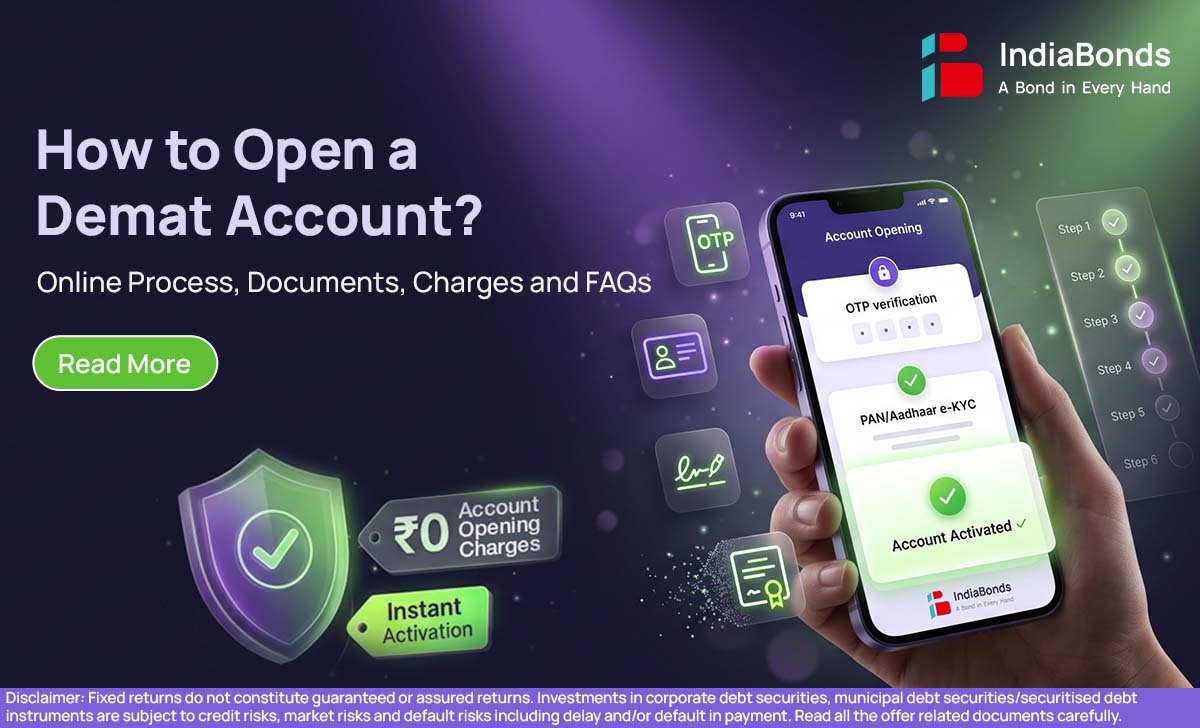
Imagine wanting to make your first investment. You have the money, you know what you want to buy, but then comes the paperwork: forms, signatures, KYC documents and a visit to the bank. For many first-time investors, opening a Demat account can seem like the most complicated part of getting started.
Today, however, this process can be completed entirely online. A Demat account is essentially a digital account used to hold securities such as bonds, shares and other eligible investments. Its utility is simple: it keeps your investments in electronic form, making them easier to hold, track and manage.
With IB Demat, this convenience goes a step further, the account is built specifically to help you buy, sell and consolidate your fixed-income portfolio in one place, at zero cost, without any paperwork.
Key Takeaways
- A Demat account can generally be opened through a registered Depository Participant (DP) such as a bank or broker.
- Online opening usually involves KYC, PAN, identity and address verification. This entire process is 100% paperless, and can take anywhere from a few minutes to a few days depending on your KYC status.
- Account-opening charges and annual maintenance charges (AMC) vary between DPs, ranging from ₹0 to ₹850 for opening and ₹0 to ₹900 for AMC.
- Investors can also choose to complete the process at a bank branch or DP service center, though most platforms now offer 100% online journeys.
- Before choosing a DP, compare charges, services, customer support and digital facilities based on your investment goals, equities, bonds, or both.
How To Create Demat Account
How do you open a demat account? At its core, it’s just linking your identity and bank details to an electronic record maintained by a depository, so your securities can be held and moved without paper. The benefit is simple: your holdings become instantly transferable, verifiable, and free of the risks that paper certificates once carried. For bond investors, this matters even more, coupons are credited automatically, redemptions happen on their own, and every bond you own, no matter where you bought it, can sit in one account instead of scattered across statements from different platforms.
How to Open a Demat Account Online?
For the most part, this is now a self-service process. Every registered Depository Participant, whether a bank, a discount broker, an OBPP or a fixed-income-focused platform, lets you complete the entire journey on their website or app, without a single visit to a branch.
What are the steps to open a demat account for beginners? Strip away the branding differences between providers, and the process almost always follows the same broad arc:
- Pick a SEBI-registered DP that matches what you want to invest in bonds, equities or both.
- Register with your mobile number and email, usually verified with an OTP.
- Provide your PAN and complete e-KYC, which most DPs now do by fetching your Aadhaar details automatically.
- Link a bank account, add nominee details, and fill in a short investor profile.
- Review and e-sign your application, after which the DP activates your account.
How do I open a Demat account for stock market investing? If your goal is to buy and sell listed shares, you’ll typically need a trading account alongside your demat account, since the trading account is what places your order on the exchange, most brokers bundle the two together during onboarding. If you’re investing purely in bonds, though, a demat account on its own is often enough: platforms settle many bond trades through the request-for-quote or over-the-counter route, so a separate trading account isn’t always required.
What documents are required to open a Demat account? PAN is non-negotiable across every DP. Beyond that, you’ll typically need one identity/address proof – Aadhaar, passport, voter ID or driving license, along with your bank details.
The exact list, and how much of it is verified digitally versus in person, varies quite a bit by provider.
Choosing Your Depository Participant (DP)
Before you open an account, you need to pick which DP to use. This is the most important decision – charges, speed, and product access all depend on it.
| DP Type | Examples | Cost (Opening + Annual) | Best For | Speed | Trade-offs |
| Broker DPs | Zerodha, Motilal Oswal, Groww, Angel One | Opening: ₹0 – ₹200 Annual: ₹0 – ₹300 | Stock traders, active equity investors | 10 – 30 min online | Limited support, minimal hand-holding |
| Bank DPs | HDFC, ICICI, Axis, SBI | Opening: ₹200 – ₹500 Annual: ₹300 – ₹600 | Existing bank customers, conservative investors | 1 – 2 days (offline + branch) | Higher fees, slower onboarding |
| Specialty Platforms | IndiaBonds (bond-focused demat) | Opening: ₹0 Annual: ₹0 | Bond investors, consolidated fixed-income portfolios | Instant online 100% digital | Limited to fixed-income products |
Steps to Open a Demat Account with IndiaBonds
If you’re looking for a platform specifically optimized for bonds, here’s what the process looks like with IndiaBonds, built to be simple enough for a first-time investor and quick enough that you won’t lose interest halfway through:
Step 1: Choose Your DP
IndiaBonds is a SEBI-registered stockbroker and depository participant, built specifically for fixed-income investors. Rather than juggling a separate demat for bonds and another platform for tracking them, IndiaBonds lets you buy, sell and hold your entire bond portfolio in one place.
Step 2: Start the Application
On the IndiaBonds website or app, enter your mobile number and email ID and verify both with an OTP. There are no forms to download and nothing to print.
Step 3: Enter Your Details
Your PAN and Aadhaar details are fetched and verified automatically, carrying over your name, date of birth and address so you don’t have to re-enter them manually.
Step 4: Complete KYC
Add your bank details (IFSC, bank name, account type and account number). IndiaBonds verifies this with a small refundable deposit.
Next, set up your demat details and optionally add up to three nominees, followed by a few profile details covering your risk profile, investing experience and income range.
Step 5: Submit and e-Sign
Complete your e-sign using your PAN, Aadhaar and OTP to finalize your KYC record.
Step 6: Receive Your Account Details
Once verified, your IB Demat account is typically activated instantly, with no waiting period and you’re ready to start investing with as much as ₹1,000.
Timeline & Activation Expectations
How long your account takes to activate depends on the state of your KYC record:
| KYC Status | Fix Needed | Account Activation | Ready to Trade |
| Already validated | None | Instant – 5 minutes | Immediately after e-sign |
| On Hold | 5 -15 minutes (update mobile/email on KYC portal) | 1 -2 hours after fix | Same day |
| Needs video KYC | Schedule a slot (2 – 24 hours) | 1 – 2 hours after video | Next business day |
| Offline at a bank branch | 30-minute in-branch application | 3 – 5 business days | Next week |
Common Mistakes That Slow Down or Block Your Application
| Mistake | Problem | Fix |
| Aadhaar–mobile mismatch | Registered mobile ≠ Aadhaar mobile – OTP fails. | Update mobile at uidai.gov.in, then retry. |
| PAN name ≠ Aadhaar name | Spelling mismatch flags KYC. | Correct PAN at pan.utiitsl.com or via ITR filing. |
| Bank name ≠ demat name | Settlement fails when you sell. | Keep the same name on PAN, Aadhaar, bank and demat. |
| Nominee not added | Risks a debit freeze later. | Add nominees (up to 3) at signup; update anytime. |
| Forgotten password | No easy self-reset on many platforms. | Try ‘Forgot Password’ first; else contact your DP (24 – 48 hrs). |
Charges for Opening a Demat Account
There is no single fee applicable to every Demat account, charges are levied in layers, by different parties.
| Charge | Typical Market Range | IndiaBonds |
| Account opening | ₹0 – ₹850 | ₹0 |
| Annual Maintenance (AMC) | ₹250 – ₹900/year | ₹0, regardless of holding value |
| Transaction (sell) charge | ₹15 – ₹20 + GST per sell, per ISIN | Buying is free; a per-debit charge applies on selling, as with any DP |
| Custodian / safety fee | ₹0.40 – ₹1 per ISIN, per month | Not charged |
Documents Required to Open a Demat Account
What documents are required to open a demat account? That depends on whether you’re doing it offline at a bank branch or online with a platform and the difference is bigger than most people expect.
At a Bank Branch
- PAN, which SEBI lists as mandatory for every applicant.
- Aadhaar, passport, voter ID or driving license, for identity and address verification.
- An eligible bank statement, passbook or utility bill, if separate address proof is needed.
- A passport-size photograph.
- Completed account-opening and KYC forms, signed in person.
Online (e.g., with IndiaBonds)
- PAN, fetched and verified electronically, no physical copy needed.
- Aadhaar, used for both identity/address verification and your final e-sign.
- A linked bank account, verified digitally through a small refundable deposit.
- No photograph, printed forms, or in-person signature required.
NRIs and a few specific account types may need to submit limited additional documents. In short, the paperwork hasn’t disappeared, it’s just been replaced by verifications that happen electronically, in the background, while you complete each step online.
The KYC Registration Check Nobody Explains
Every ‘5-minute demat account’ claim assumes one thing is already working in your favor: that your PAN already carries a clean KYC record. Here’s what’s actually happening behind that instant-activation promise and why it isn’t instant for everyone.
Under SEBI’s KYC Registration Agency (KRA) framework, your identity isn’t verified fresh every single time you open an account. Five SEBI-registered KRAs – CVL KRA, NDML, CAMS KRA, KFintech and DotEx, hold a shared, central record of every investor’s KYC. The moment you submit your PAN to open a demat account, your DP doesn’t start from scratch; it checks this shared database and gets back one of three answers:
KYC Validated/Registered:
Your record is clean and current. This is the fast lane, your DP can pull your verified identity and address without asking you for anything further, which is how ‘instant’ activation actually happens.
KYC On Hold:
Something in your record needs fixing before it can be reused, an unverified mobile number or email, a PAN not linked to Aadhaar, or outdated proof like an old utility bill that SEBI no longer accepts as primary address proof.
KYC Rejected/Under Process:
A mismatch was flagged somewhere, and it needs manual correction before any new account, demat or otherwise can be opened against that PAN.
This explains something most explainers skip entirely: two people can follow the exact same steps on the exact same platform, and one account activates in minutes while the other sits pending for days. The difference usually has nothing to do with the DP, it’s the state of a KYC record they created years ago, possibly with a completely different broker or mutual fund, that’s now quietly blocking or clearing every new account they try to open.
Practical takeaway: before you begin, it’s worth checking your own status on any KRA’s website using just your PAN. If it shows On Hold, fixing the flagged issue first, usually a two-minute job like re-verifying your mobile number or linking PAN to Aadhaar, will get you through account opening faster than simply retrying the application itself.
Factors to Consider When Choosing a Demat Account
Choosing a demat account is not simply about finding the lowest fee. Consider these factors before opening one:
Charges:
Compare account-opening fees, AMC, transaction and other service charges across DPs.
DP and Depository:
India has two depositories, NSDL and CDSL. Your DP provides the actual account and services, so compare the intermediary as well. Most DPs are regulated equally, but some offer better apps, faster settlement, or better customer support.
Digital Experience:
Check whether the app or website makes it easy to view holdings, statements and transactions. Some platforms consolidate your portfolio data better than others.
Customer Support:
Good support can be important when dealing with KYC issues, account access or securities-related requests.
Investment Needs:
If you plan to invest in bonds, G-Secs, SDLs, SGBs or other fixed-income products, check whether the DP supports the products you need. Some platforms specialize in specific asset classes.
Security and Transparency:
Choose a regulated intermediary and read the tariff, account terms and applicable disclosures before applying.
Conclusion
Opening a demat account no longer needs to be a paperwork-heavy process, and it can be completed in a matter of minutes online. The more important decision is choosing the right DP after understanding its charges, services and suitability for your investment needs.
A demat account is ultimately a digital home for your securities, so comparing providers before opening one can help you avoid unexpected costs and make investing easier to manage.
Frequently Asked Questions
Can I open a Demat account myself?
Yes. With most online platforms, you can apply directly through the website or app. The process involves mobile and email verification, PAN and KYC checks, and e-sign, all completed by you, online, without visiting a branch.
How much money is required to open a Demat account?
There is no minimum amount required simply to open a demat account with most DPs. Many charge zero opening fee and zero AMC. Once open, you can start investing in bonds or stocks with as little as ₹1,000 – ₹5,000 depending on the instrument.
Which Demat account is free?
Many brokers now offer free or near-free demat accounts (₹0 opening fee, ₹0 AMC). IndiaBonds charges ₹0 for account opening and ₹0 annual maintenance charge for bond investors. As with any DP, transaction charges may apply when you sell securities, so it’s worth checking the complete tariff schedule.
How do I open a Demat account online?
Verify your mobile and email with OTP, complete PAN and Aadhaar-based KYC, add your bank and demat details, fill in your profile information, and finish with your wet signature and e-sign. See the step-by-step section above for the full walkthrough.
What documents are required to open a Demat account?
Just your PAN and Aadhaar if you’re opening online, both are used for online verification, so no physical paperwork is needed. See the comparison section above for what’s needed at a bank branch instead.
Do I need a trading account to buy bonds?
Not necessarily. A demat account alone is enough for most bond purchases, especially through platforms that settle OTC (over-the-counter). You only need a trading account if you plan to buy listed shares or trade equities on the NSE/BSE.
Can I open a joint Demat account?
Yes, most DPs allow joint demat accounts with up to 3 holders (one primary holder and two joint holders). However, trading accounts linked to joint demats often have restrictions, check with your DP.
What if my Aadhaar and PAN names don’t match?
This is one of the most common reasons KYC gets flagged. Fix your PAN at the PAN portal or through your ITR filing to match your Aadhaar name exactly. Then retry your account opening application.
Disclaimer : Fixed returns do not constitute guaranteed or assured returns. Investments in corporate debt securities, municipal debt securities/securitised debt instruments are subject to credit risks, market risks and default risks including delay and/or default in payment. Read all the offer related documents carefully.
496