

Download IndiaBonds App
400K+ Downloads

 Search


How To Open Post Office Fixed Deposit Account Online
 1.14K
1.14K
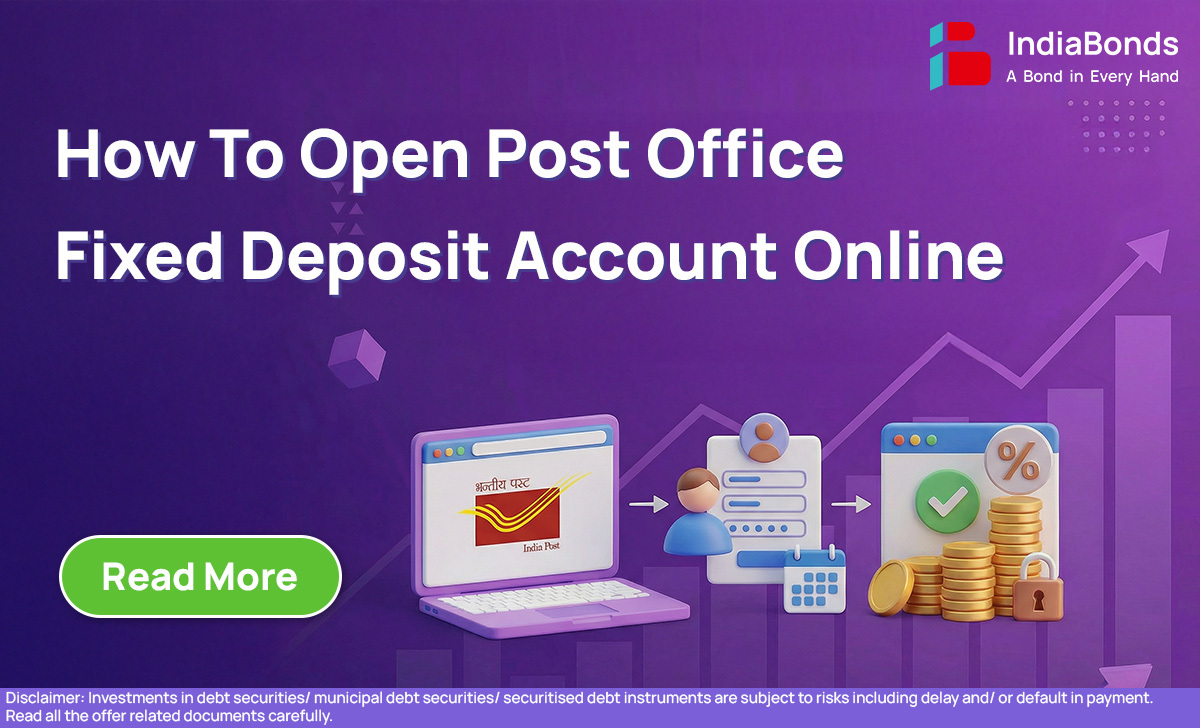
If you grew up in an Indian household, chances are the post office wasn’t just a place to mail letters. It was where passbooks lived, where grandparents parked savings, and where money felt… safe. That trust hasn’t disappeared. Even today, the Post Office Fixed Deposit is a familiar choice for people who want peace & don’t want to risk their corpus amount saved for years.
The nice part? You don’t always have to visit a branch anymore. If you already have a post office savings account with internet banking enabled, you can open post office FD online in a few minutes. No need to stand in long queues, no lengthy forms, and no second trip because you forgot a signature.
This blog breaks down the post office FD scheme, what you get with it, and the exact steps on how to open FD in post office online—without overcomplicating it.
Post Office FD Scheme
The post office FD scheme is officially called the National Savings Time Deposit Account. Think of it as the post office version of a bank FD: you invest a lump sum, pick a tenure, and the interest rate is fixed at the time you open the deposit.
What people like about it is the straightforwardness. There are no moving parts. No market ups and downs. And because it sits under India Post’s savings framework, it’s widely viewed as a conservative way to park money—especially for short-to-medium term goals.
The best part for modern investors is that you can now handle the entire thing through post office time deposit online (as long as your savings account is set up for it).




Features of Post Office FD Scheme
The Post Office FD isn’t trying to look fancy. It’s built for people who want clarity—how much they’re putting in, how long they’re locking it, and what interest rate applies.
Here are the key features of Post Office Fixed Deposits that most investors care about:
- Guaranteed returns: Once you book the deposit, the interest rate stays the same for that tenure.
- Tenure choices: You can pick 1, 2, 3 or 5 years—no confusing options.
- Capital safety: It’s a government-backed product, which is why conservative investors prefer it.
- Tax angle (only for one tenure): The 5-year option may qualify for deduction under Section 80C (within limits).
- Low starting amount: The minimum is ₹1,000, so you don’t need a large lump sum to begin.
- Nomination facility: You can add a nominee at the start or update it later.
- Transferable account: If you move cities, the account can be shifted between post office branches.
If your goal is stability more than “max returns”, these features fit neatly into that mindset.
How to Open FD in Post Office Online?
Let’s get to the main part—how to open post office FD online.
Before anything else, here’s the one condition that matters: you need an active Post Office Savings Account with internet banking enabled. If that’s in place, the rest is a clean digital flow.
Here’s how to open post office FD online step-by-step:
- Log in to the India Post internet banking portal using your credentials.
- Go to General Services and select Service Requests.
- Click on New Request.
- Choose TD Account (Time Deposit) / “Open a TD Account (FD)”.
- Enter the deposit amount, select the tenure, and choose the account to be debited.
- Review the details (this is where most mistakes happen—double-check tenure and amount).
- Enter your transaction password and submit.
That’s it. Your deposit should reflect in your account. In other words, post office fixed deposit online opening is simple—as long as your savings account and net banking are active.
Interest Rate
The post office FD interest rate is decided by the Ministry of Finance and revised every quarter. The practical point to remember is this: the rate that applies to you is the rate on the day you open the FD, and it stays locked for the chosen tenure.
Here’s a table of the commonly referenced rates:
| Tenure | Interest Rate (p.a.) |
| 1 Year | 6.9% |
| 2 Years | 7.0% |
| 3 Years | 7.1% |
| 5 Years | 7.5% |
If someone is specifically looking for the “best” option within this scheme, the 5-year deposit often has the highest rate—though rates can change each quarter.
Eligibility and Documents Required
The eligibility rules are broad, which is why this product is used across age groups.
Eligibility
- Resident Indian individuals
- Minors aged 10 years and above (in their own name)
- Guardian on behalf of a minor or a person of unsound mind
- Joint accounts (up to three adults)
Documents Required
- Post Office Savings Account passbook (or account details)
- For offline opening: A-Slip and pay-in slip (cash/cheque deposits)
- For online opening: an active savings account with internet banking is usually enough
Conclusion
A Post Office FD is not a “returns hack.” It’s a “sleep well at night” product. It works best when your goal is to keep money safe, avoid market risk, and earn a predictable return over a fixed period.
And now that you can open post office FD online, it fits better into the way people manage money today—quickly, digitally, and without repeated branch visits.
If you already have a post office savings account with net banking enabled, post office FD account opening online is genuinely one of the smoother fixed-income processes out there.
Frequently Asked Questions (FAQs)
1. Does the interest in a post office FD account accumulate over time?
No, the annual interest is credited to the depositor’s linked Post Office Savings Account. It does not compound within the FD account itself unless the depositor chooses to reinvest it.
2. What is the time frame for choosing the extension facility during the deposit term?
The account holder can apply for an extension of the FD account for another tenure. This request must be submitted within a specific period:
- For a 1-year TD: Within 6 months of maturity.
- For a 2-year TD: Within 12 months of maturity.
- For 3/5-year TD: Within 18 months of maturity.
3. What documents are needed for the premature closure of the fixed deposit account?
For premature closure, you will need to submit the duly filled account closure form along with your passbook at the respective post office branch.
4. Is interest income from Post Office FDs taxable?
Yes, the interest earned from a Post Office FD is fully taxable as per your income tax slab. If the annual interest income exceeds ₹40,000 (₹50,000 for senior citizens), TDS will be deducted. However, the investment made in a 5-year Post Office FD is eligible for tax deduction under Section 80C.
5. What is the maximum amount of investment into the post office fixed deposit account?
There is no maximum limit on the amount you can invest in a Post Office Fixed Deposit account. The minimum investment is ₹1,000, and you can invest any amount above that in multiples of ₹100.
Disclaimer : Investments in debt securities/ municipal debt securities/ securitised debt instruments are subject to risks including delay and/ or default in payment. Read all the offer related documents carefully. The inventories offered on the platform offer interest upto 12% returns.
1.14K













CIN: U67100MH2008PTC178990
SEBI Registration No.: INZ000311637
NSE Member ID - Debt Segment: 90316
BSE Member ID - Debt Segment: 6811
Caution : Beware of fraudsters and impersonators misusing the name of IndiaBonds. Always verify communications and transactions through our official website www.indiabonds.com and mobile application only. Click here for Advisory and Safety Tips.