Search


Mutual Fund SIP vs Bond SIP – What’s the Difference & Which One to Choose?
 1.62K
1.62K
If you have been investing for even a year or two, chances are you already have a mutual fund SIP running. ₹2,000 here, ₹5,000 there, quietly going in every month while you get on with life. It works. That is exactly why the SIP format has taken off the way it has in India.
But here is something worth knowing you can now do the same thing with bonds. Not bond funds, actual bonds. A Bond SIP lets you put money into individual debt instruments every month, exactly the way you would invest in a mutual fund SIP. Same discipline, very different product. And the differences between a Bond SIP vs Mutual Fund SIP matter more than most investors initially expect.
Bond SIP vs Mutual Fund SIP: What’s the Difference and Which is Better for You?
The format is similar: you set an amount, it gets invested on a schedule, and you build a corpus over time. But what happens to that money once it is invested is a completely different story.
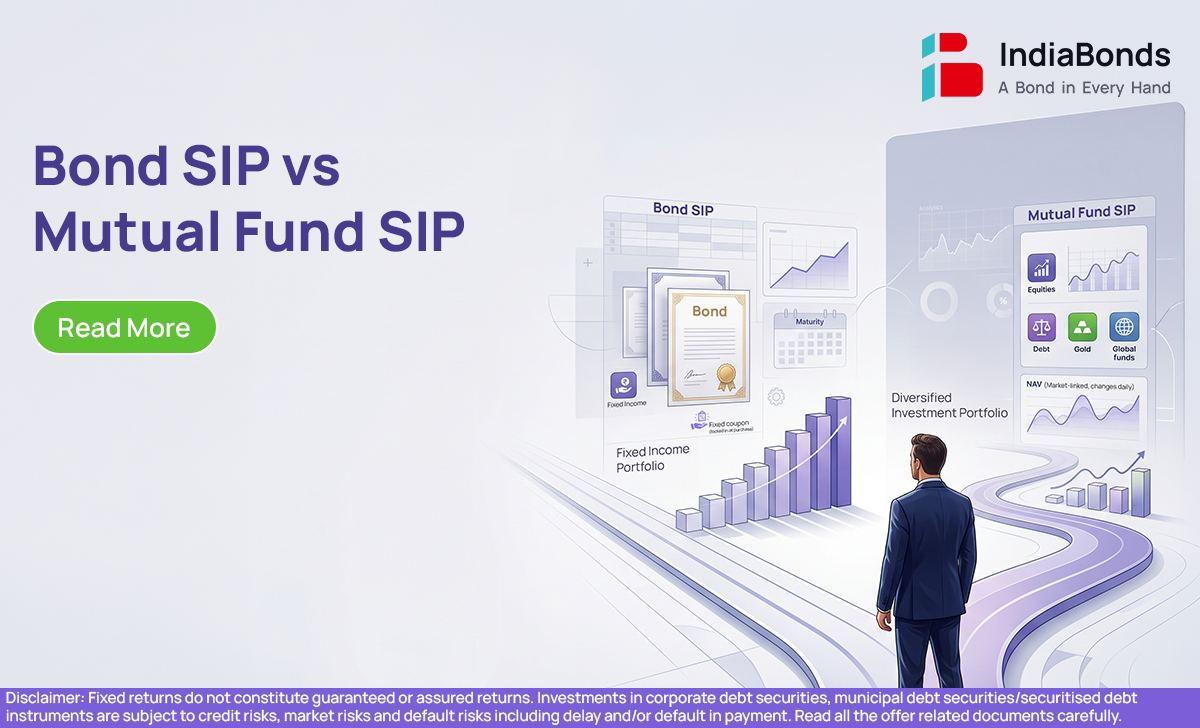
With a Mutual Fund SIP, your money goes into a pool managed by a fund house. A professional fund manager decides which bonds to buy and sell inside the fund. You do not own any bond directly. You own units of the fund, and those units change in value every single day. With a Bond SIP, each monthly instalment goes towards purchasing actual bonds. You know who issued them, what interest rate they carry, and when your money comes back. That is the core difference between Bond SIP and Mutual Fund SIP: one gives you fund units, the other gives you direct ownership.




Direct Ownership vs Fund Structure: The Fundamental Difference
When you invest in a debt mutual fund, you are handing your money to someone else and saying, find the best bonds to buy. The fund manager selects instruments, manages duration, rebalances the portfolio. You see the outcome in your NAV every day, but the actual portfolio comes to you as a monthly factsheet. That is about it.
A Bond SIP works differently. Every month, you are buying a specific bond. Say a listed NBFC paper with a AAA rating, maturing in three years, paying 8.6% annually. It sits in your Demat account. You can see it. You know exactly what you own, what it will pay you, and when the principal returns. There is no fund manager between you and your investment, no pooling with other investors’ money.
This matters more than it sounds. In a mutual fund, even one bad credit call by the manager, one IL&FS-type situation in the portfolio, can dent your returns meaningfully. With direct bond ownership through a Bond SIP, you choose the issuer. You choose the rating. The risk stays where you can see it, and that kind of transparency is hard to replicate in a corporate bond SIP vs mutual fund comparison.
Returns: Fixed Coupon vs Market-Linked NAV
When you invest in a debt mutual fund SIP, no one can tell you what your returns will be. Not even the fund manager. NAV depends on where interest rates go, how credit spreads move, and a range of other market variables. In a falling rate cycle, debt fund NAVs tend to do well. But when the RBI starts hiking rates, NAVs get hit. Investors who have held long-duration debt funds through a tightening cycle know exactly how uncomfortable that can feel.
Buy a bond through a Bond SIP and the conversation is different. If you lock in at 8.75% per annum today, that is your rate. The RBI can hike, cut, or do nothing. Your coupon does not change. For anyone planning around a specific income target, whether it is an EMI, a school fee, or a retirement draw, that predictability is worth more than the potential upside of a market-linked NAV.
Risk Profile Compared
Both products carry risk. The type of risk is what differs, and knowing which you are taking on is half the job.
Debt mutual funds carry interest rate risk: when rates rise, NAVs fall. They also carry credit risk spread across an entire portfolio of bonds, some of which you may never have heard of. And then there is fund manager risk, the possibility that the calls made on your behalf do not work out.
With a Bond SIP, if you are buying investment-grade paper (AA or above) and holding to maturity, the daily noise of the market does not apply to you. Your principal is due back in full on the maturity date. The one real risk is issuer default, which is why sticking to well-rated, listed instruments matters. Platforms like IndiaBonds screen bonds and provide credit information so retail investors are not going in blind.
Taxation: Bond SIP vs Debt Mutual Fund SIP
Tax treatment changed significantly for debt mutual funds after April 2023, and it has shifted the comparison between Bond SIP and Mutual Fund SIP in a direction that benefits direct bond investors.
Bond SIP, coupon income:
The interest you earn is added to your income and taxed at your applicable slab rate.
Bond SIP, capital gains on sale:
Sell a listed bond within 12 months and the gain is taxed at your slab rate. Hold it beyond 12 months and it is long-term capital gains at 10%, with no indexation.
Debt Mutual Fund SIP:
Before April 2023, gains held over 3 years were taxed at 20% with indexation. That advantage is gone. All debt mutual fund gains, regardless of holding period, are now taxed at your slab rate.
For investors in the 30% bracket, direct bonds via Bond SIP now come out ahead on tax efficiency. Long-term capital gains at 10% versus slab rate on everything is a meaningful difference over a multi-year holding period.
Tax rules can change. Verify the current position with a CA or tax adviser before making decisions based on tax treatment alone.
Side-by-Side Comparison: Bond SIP vs Mutual Fund SIP
| Parameter | Bond SIP | Mutual Fund SIP (Debt) |
| What you own | Individual bonds in your Demat account | Units of a pooled fund; no direct bond ownership |
| Returns | Fixed coupon, locked in at purchase | Market-linked NAV, changes daily |
| Transparency | Full: you see every instrument you hold | Monthly factsheet; limited real-time visibility |
| Interest rate risk | Low if held to maturity | Higher; NAV moves with every rate change |
| Credit risk | Specific to the issuer you have chosen | Spread across the fund’s portfolio |
| Taxation | Coupon at slab; LTCG at 10% after 12 months | All gains at slab rate (post April 2023) |
| Regulation | SEBI and RBI; listed on BSE/NSE | SEBI regulated under AMC/AMFI framework |
| Exit flexibility | Sell on secondary market or hold to maturity | Redeem at NAV anytime; exit load may apply |
| Minimum to start | From ₹1,000/month on IndiaBonds | Typically ₹500 to ₹1,000/month |
Which Should You Choose?
It depends on what you want from your fixed-income allocation.
If you want to know with certainty what your investment will earn, when your principal comes back, and who exactly owes you money, a Bond SIP is built for that. It suits conservative investors, retirees building income streams, and anyone who has grown tired of NAV-watching in their debt fund portfolio. The post-2023 tax changes have only made the Bond SIP vs Mutual Fund SIP case more compelling for longer-term investors.
If you would rather not evaluate individual issuers, want risk spread across dozens of bonds without doing the legwork, and need high short-term liquidity, a debt mutual fund SIP still has a place, particularly for goals under two years. But for longer horizons where income predictability matters, the difference between Bond SIP and Mutual Fund SIP becomes increasingly difficult to argue away.
Conclusion
A Bond SIP and a Mutual Fund SIP are not two versions of the same thing. One gives you ownership and certainty. The other gives you managed diversification. Knowing which matters more for your goal is where the decision starts.
FAQs
Can I invest in both Bond SIP and Mutual Fund SIP simultaneously?
Yes, and many investors do exactly that. A debt mutual fund SIP handles short-term liquidity needs, money you might need in a year or two, while a Bond SIP builds a longer-term, income-generating position. They serve different purposes and can coexist in the same portfolio without conflict.
Which gives better returns: Bond SIP or Mutual Fund SIP?
Quality corporate bonds on IndiaBonds are currently offering 8 to 9.5% per annum in coupon income, fixed and locked in at purchase. Debt mutual funds may deliver similar numbers in some years but can underperform in rising rate environments. On a post-tax basis, with the indexation benefit on debt funds now removed, Bond SIPs compare very competitively for investors in higher tax brackets.
Is Bond SIP taxed the same as debt mutual funds?
Not exactly. Coupon income from a Bond SIP is taxed at your slab rate. If you sell a bond after 12 months, any capital gain is taxed at 10% (long-term capital gains, no indexation). Debt mutual funds lost their indexation advantage in April 2023, so all gains regardless of holding period are now taxed at slab rate. That shift has made the Bond SIP comparatively more tax-efficient for longer holding periods.
Is a Bond SIP regulated by SEBI?
Yes. Bonds listed on recognised exchanges, BSE and NSE, come under SEBI’s regulatory oversight. Government securities additionally fall under RBI’s purview. IndiaBonds operates as a SEBI-registered Online Bond Platform Provider, so the bonds listed and the transactions made through the platform are within a regulated framework. Disclosure requirements, rating mandates, and investor protection norms all apply.
What is the exit option in Bond SIP compared to Mutual Fund SIP?
With a debt mutual fund, you can redeem at NAV on any business day, though some funds charge an exit load if you leave within the first year. With a Bond SIP, the cleanest exit is holding to maturity and collecting your principal in full on the due date. If you need to exit early, listed bonds can be sold on the secondary market. Liquidity varies by bond: well-rated, shorter-duration paper tends to be easier to sell. Matching your time horizon to the bond’s maturity is the cleaner way to manage that variable.
Disclaimer – Fixed returns do not constitute guaranteed or assured returns. Investments in corporate debt securities, municipal debt securities/securitised debt instruments are subject to credit risks, market risks and default risks including delay and/or default in payment. Read all the offer related documents carefully.
1.62K