Search


Overnight Index Swaps (OIS): Meaning, Working and Calculation
 300
300
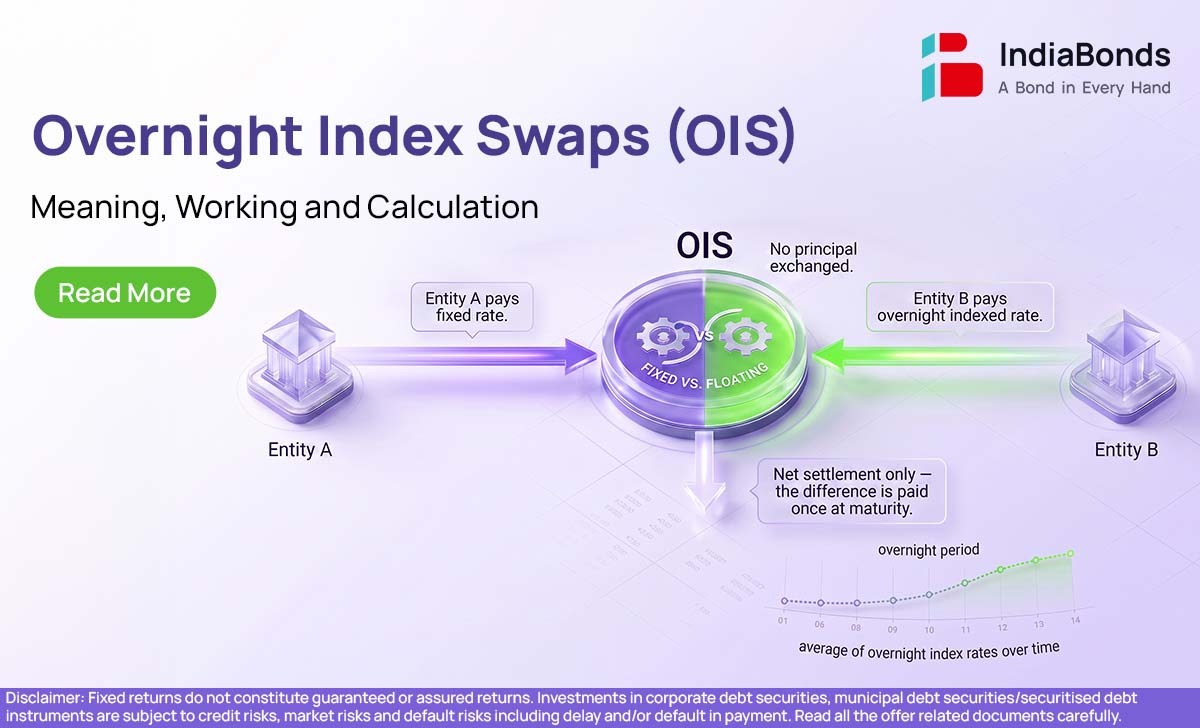
Interest rates can change quickly, but loans and investments often continue for months or years. This creates uncertainty for banks, companies and investors. Overnight Index Swaps help manage that uncertainty. Through an OIS, two parties exchange fixed and floating interest payments, with the floating side linked to a compounded overnight interest rate.
Key Takeaways
- An OIS exchanges a fixed interest rate for a compounded overnight rate.
- The principal amount is used only for calculation and is not normally exchanged.
- Payments are usually settled on a net basis.
- The floating rate is calculated from daily overnight rates.
- OIS rates often reflect market expectations about future monetary policy.
- The OIS curve shows rates across different contract tenures.
- OIS contracts still carry market, counterparty and basis risks.
What Is an Overnight Index Swap (OIS)?
An Overnight Index Swap is an interest-rate derivative. One party agrees to pay a fixed rate, while the other pays a floating rate based on a recognised overnight benchmark.
The floating payment is not normally based on a single day’s rate. Daily overnight rates are compounded over the agreed period. At settlement, this compounded return is compared with the fixed overnight index swap rate agreed at the beginning.
Only the difference between the two interest amounts is generally paid. The notional principal is used for the calculation but does not ordinarily move between the parties.
In India, MIBOR has traditionally been used as the underlying reference rate for rupee OIS contracts. Financial Benchmarks India Private Limited publishes the Overnight MIBOR and a MIBOR-OIS curve for several tenures.
The OIS rate is the fixed rate of the contract. Broadly, it reflects the market’s expected path of overnight interest rates over the swap’s tenure.




Functionality of Overnight Index Swaps
Consider a bank that has borrowed money at a floating interest rate. Its funding cost may rise if overnight rates increase. The bank may enter into an OIS in which it pays a fixed rate and receives the compounded overnight rate. A rise in the floating payment can then help offset the increase in its borrowing cost.
The contract usually works through the following steps:
- The two parties choose the notional principal.
- They decide the starting date and maturity.
- A fixed OIS rate is agreed.
- A recognised overnight benchmark is selected.
- Daily overnight rates are observed during the contract period.
- These daily rates are compounded.
- The floating payment is compared with the fixed payment.
- Only the net difference is settled.
Suppose one party pays a fixed rate of 5.50% and receives the floating rate. If the compounded overnight rate reaches 5.80%, the party receives the difference. If the compounded rate is only 5.20%, the party makes the net payment instead.
This structure means an OIS is not a one-sided guarantee. One party gains from a rate movement while the other makes the corresponding payment.
The overnight index swap curve places OIS rates of different maturities together. It may contain rates for one month, three months, one year and longer periods. In India, FBIL’s published MIBOR-OIS curve includes tenors from one month to five years and is constructed using eligible market transactions reported to CCIL.
A rising curve may suggest that the market expects overnight rates to move higher over time. A falling curve may point to expectations of lower rates. However, the curve can also reflect liquidity, demand, supply and market positioning. It should not be treated as a guaranteed forecast.
An institution may use OIS contracts for:
- managing floating-rate borrowing costs;
- protecting income earned on interest-sensitive assets;
- expressing a view on future interest rates;
- valuing other interest-rate derivatives;
- studying monetary-policy expectations; and
- reducing mismatches between assets and liabilities.
CCIL provides clearing services for eligible rupee interest-rate swaps linked to MIBOR and MIOIS benchmarks. It also supports trades completed through the ASTROID platform.
Calculating an Overnight Index Swap: A Step-by-Step Guide
Overnight index swap pricing begins by finding the value of the fixed and floating sides of the contract.
At the start of a new OIS, the fixed rate is generally chosen so that the present value of both sides is approximately equal. The contract therefore begins with little or no value, apart from transaction costs and related adjustments.
Step 1: Calculate the compounded overnight return
The floating rate is found by compounding each daily overnight rate:
Compounded Return =
[(1 + r₁ × d₁/D) × (1 + r₂ × d₂/D) × … × (1 + rₙ × dₙ/D)] − 1
Where:
- r is the overnight rate for each observation period;
- d is the number of days for which that rate applies; and
- D is the day-count base, such as 360 or 365.
A Friday rate, for example, may apply for more than one calendar day when the next business day falls after a weekend. The contract terms determine the exact convention.
Step 2: Calculate the floating payment
Floating Payment = Notional Principal × Compounded Return
Step 3: Calculate the fixed payment
A simplified fixed-side calculation is:
Fixed Payment = Notional Principal × Fixed OIS Rate × Day-Count Fraction
Step 4: Find the net settlement
For a party receiving floating and paying fixed:
Net Settlement = Floating Payment − Fixed Payment
The direction is reversed for the party receiving fixed.
Overnight index swap example
Suppose an institution enters into a three-month OIS with these terms:
| Contract detail | Value |
| Notional principal | $10,000,000 |
| Fixed OIS rate | 5.00% |
| Realised compounded overnight rate | 5.30% |
| Contract period | 90 days |
| Day-count basis | 360 |
The fixed payment is:
$10,000,000 × 5.00% × 90/360 = $125,000
The floating payment is:
$10,000,000 × 5.30% × 90/360 = $132,500
The net amount is:
$132,500 − $125,000 = $7,500
The party receiving floating and paying fixed receives $7,500. The other party pays the same amount.
This is a simplified overnight index swap example. Actual contracts may include daily compounding, payment delays, business-day adjustments, collateral terms, discounting and clearing costs.
Understanding OIS valuation after the trade begins
The market value of an existing OIS can change before maturity. Suppose a party agreed to pay fixed at 5%, but comparable new swaps are now available at 4.50%. Paying 5% has become less attractive, so the position may carry a negative value for the fixed-rate payer.
In practice, valuation involves:
- forecasting the remaining overnight rates;
- calculating expected floating cash flows;
- calculating the remaining fixed cash flows;
- discounting both sets of payments; and
- finding the difference between their present values.
CCIL’s valuation process estimates floating-side cash flows using forward rates derived from the relevant zero-rate curves.
A person searching for the overnight index swap rate today should check the latest tenor-wise data rather than relying on an older article. FBIL publishes MIBOR-OIS benchmark information, while CCIL displays market information for interbank rupee interest-rate swaps. The rate must always be read with its date and tenure because there is no single OIS rate for every maturity.
Conclusion
An Overnight Index Swap exchanges a fixed interest rate for a floating payment linked to compounded overnight rates. It can help institutions manage future borrowing costs and interest-rate exposure. Still, the calculation is more detailed than simply comparing two quoted rates. The benchmark, tenure, compounding method, discount curve and settlement terms all influence the final value.
FAQs
What are overnight indexed swaps?
Overnight indexed swaps are derivative contracts in which one party pays a fixed rate and the other pays a floating rate based on compounded overnight benchmark rates. The payments are calculated using a notional principal and normally settled on a net basis.
What is an overnight rate swap?
An overnight rate swap is another name commonly used for an OIS. It exchanges fixed interest payments for payments linked to an overnight rate over a selected period.
What is an overnight index swap (OIS) recently seen in news?
OIS rates often appear in financial news when markets are discussing central-bank decisions. Since the fixed OIS rate reflects expectations about overnight rates over the contract period, changes in the OIS curve may indicate that traders have revised their rate expectations. This remains a market signal, not a certain prediction.
What is the difference between OIS and SOFR?
SOFR is an overnight reference rate for secured US-dollar borrowing transactions. An OIS is the derivative contract itself. A US-dollar OIS may use compounded SOFR as its floating benchmark. In other words, SOFR is a rate, while an OIS is an agreement that can be linked to that rate.
Is an Overnight Index Swap a Derivative?
Yes. It is an interest-rate derivative because its value and settlement depend on movements in an underlying overnight interest-rate benchmark. It is generally traded over the counter, although eligible trades may be centrally cleared.
Disclaimer : Fixed returns do not constitute guaranteed or assured returns. Investments in corporate debt securities, municipal debt securities/securitised debt instruments are subject to credit risks, market risks and default risks including delay and/or default in payment. Read all the offer related documents carefully.
300