Search


Term Sheet: Meaning, Importance and How Investors Should Read It
 393
393
The first time someone comes across a term sheet, it may look like one more finance document filled with formal words. But once it is read slowly, the idea is quite simple.
A term sheet is a short note that captures the main points of a deal. It tells the reader what is being offered, who is offering it, what the basic terms are and what needs attention before moving ahead. It does not usually carry every detail, but it gives a useful first view.
In investments, this first view matters. A person may be looking at a bond, a loan, a startup funding proposal or a business transaction. Before reading long agreements and detailed documents, the term sheet gives a quick sense of the structure.
For bond investors, it becomes even more useful. A bond may appear simple from the outside. There is an issuer, there is a coupon rate, there is a maturity date and there is a promise of repayment as per the terms. But behind that simple structure, there are several details that can change the investment experience. The bond may be secured or unsecured. Interest may be paid monthly, quarterly or annually. The bond may have a call option. It may have a different redemption schedule. It may be listed, but not necessarily easy to sell in the market.
A bond term sheet brings many of these details together.
What is a Term Sheet?
A term sheet is a document that summarises the main terms and conditions of a proposed transaction. In simple words, term sheet meaning can be understood as a summary of the deal.
It is used in different areas of finance. Companies use it while raising funds. Lenders use it while offering loans. Investors use it while reviewing investment opportunities. In the bond market, a corporate bond term sheet gives the key details of a bond issue.
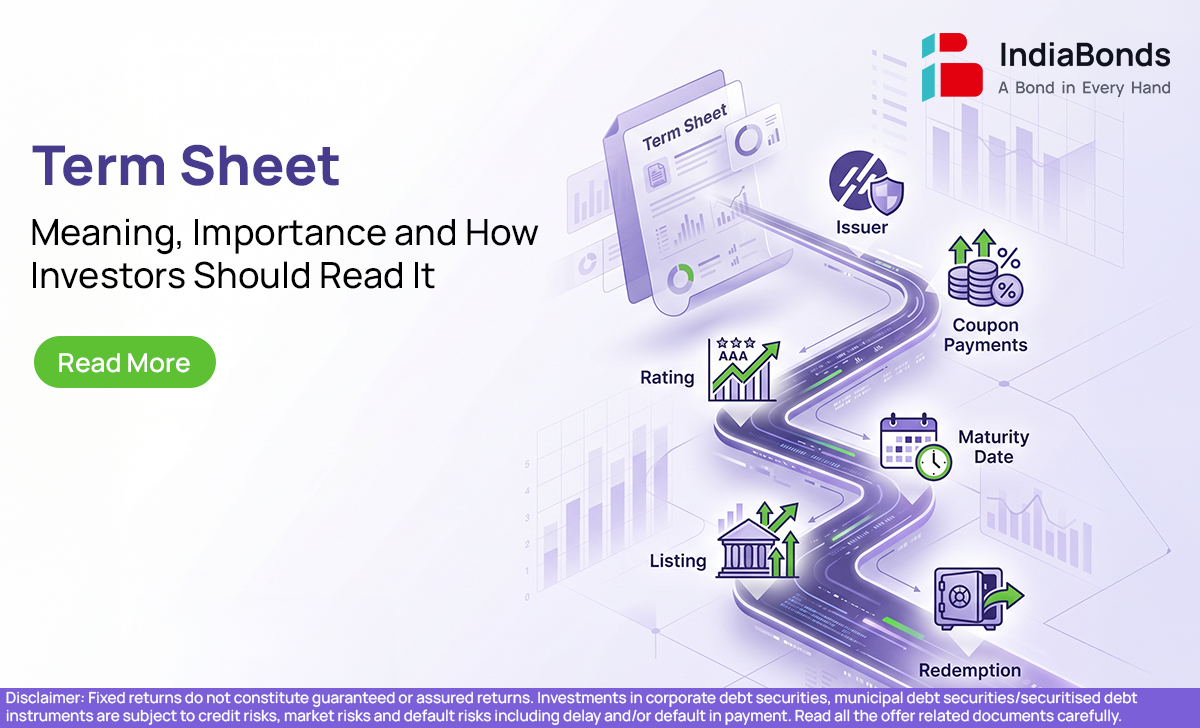
For example, if a company is issuing a bond, the term sheet may mention the name of the issuer, face value, coupon rate, payment frequency, maturity date, credit rating, security cover, listing details and redemption terms. These points help an investor understand what kind of bond is being offered.
A term sheet is usually not the final agreement. The final documents carry deeper legal, financial and risk-related information. Still, the term sheet has an important place because it helps the investor decide whether the opportunity is worth studying further.
One can think of it like checking the main details of a train ticket before starting the journey. The ticket shows the date, time, route, seat and basic information. It may not explain every rule of the railway system, but it tells the passenger enough to understand the journey. A term sheet works in a similar way for a financial transaction.




Why Investors Should Not Skip It
Many investors make the mistake of directly looking at the return figure. In bonds, that figure could be the coupon rate or yield. It is natural to notice it first, but it should not be the only thing an investor reads.
A bond with an attractive coupon may have a longer maturity. Another bond may have a lower coupon but a stronger credit profile. One bond may offer regular interest payouts, while another may pay only at maturity. In some cases, the issuer may have the right to redeem the bond early through a call option.
All these details sit inside the term sheet.
This is why the term sheet is not just a formality. It helps the investor look beyond one number. It also makes comparison easier. When two bonds are placed side by side, the term sheet can help an investor compare issuer, rating, tenor, security, payout structure and redemption terms in a more organised way.
For a new investor, this can reduce confusion. For an experienced investor, it can save time.
What a Bond Term Sheet Usually Contains
A bond term sheet may differ depending on the issuer and type of instrument. Still, some sections are commonly seen.
The first is the issuer name. This tells the investor who is borrowing money. Since the issuer is responsible for paying interest and repaying principal as per the terms, this is one of the most important points. An investor should not stop at just recognising the name. It is useful to understand what the issuer does, how it earns money and how strong its financial position appears.
The next point is the type of instrument. In India, many corporate bonds are issued as non-convertible debentures. Some may be secured. Some may be unsecured. Some may have a fixed coupon, while others may have a different structure. The type of instrument tells the investor what exactly is being purchased.
Face value is another basic but important detail. It is the principal value of each bond. Interest is usually calculated on this amount. For instance, if a bond has a face value of ₹1,000 and a coupon of 8 percent per annum, the annual interest would generally be ₹80 per bond, subject to the terms mentioned in the document.
The coupon rate is often the most visible part of the term sheet. It tells the investor the interest rate payable on the bond. But this number should be read along with other details. A coupon does not speak alone. It must be seen with credit rating, issuer profile, maturity, security and liquidity.
Payment frequency is also important. Some bonds pay interest every month. Some pay quarterly. Some pay yearly. Some may not pay regular interest at all and may instead be issued at a discount. Investors who want regular cash flow usually look closely at this section.
Then comes maturity. This tells when the bond is scheduled to be repaid. If an investor plans to hold the bond till maturity, this date becomes very important. A three-year bond and a ten-year bond do not serve the same purpose. The investor should match the maturity with personal goals and liquidity needs.
Credit rating is another key term in a term sheet. It gives an independent opinion on the creditworthiness of the issuer or instrument. A higher rating usually indicates relatively lower credit risk compared to a lower-rated instrument. However, a rating is not a guarantee. It can change if the issuer’s financial position or business environment changes.
Security details should also be read carefully. A secured bond is backed by specific assets or receivables. An unsecured bond does not have such specific backing. Security may provide comfort, but it does not remove all risks. Recovery in a stress situation may depend on asset quality, legal process and market conditions.
The redemption structure tells how the principal will be returned. Some bonds repay the full principal on the maturity date. Some repay in instalments. This may look like a small detail, but it affects cash flow planning.
The term sheet may also mention whether the bond is listed on an exchange. Listing can improve transparency and may provide an exit route through the secondary market. But investors should remember that listing does not mean there will always be enough buyers at the desired price.
Call and put options are another area that should not be ignored. A call option gives the issuer the right to redeem the bond before maturity on specified dates. A put option gives the investor the right to seek repayment before maturity, if such a feature is available. These options can change the actual holding period of the investment.
Term Sheet and Offer Document Are Not the Same
A term sheet is helpful, but it is not the full document.
The offer document, information memorandum or key information document gives deeper details. It may include risk factors, financial information, covenants, taxation points, legal disclosures and other important conditions.
So, the term sheet should be treated as the starting point. It helps the investor understand the broad structure. After that, the detailed documents should be reviewed before making an investment decision.
This point is important because a short summary can never capture everything. A term sheet may tell the investor what the bond looks like. The full documents explain the complete terms and risks.
A Simple Way to Read a Term Sheet
An investor does not need to read a term sheet in a hurry. A better approach is to go step by step.
First, the investor can look at the issuer. Who is raising money? Is the business easy to understand? What is the company’s financial background?
Second, the investor can check the rating, coupon and maturity. These three points give a basic idea of risk, return and time period.
Third, the payment frequency can be checked. This helps in understanding whether the bond matches the investor’s cash flow requirement.
Fourth, the investor should read the security and redemption details. This shows how the bond is backed and how the principal is expected to come back.
Fifth, special clauses such as call option, put option and listing details should be reviewed. These clauses are sometimes skipped, but they can make a meaningful difference.
This simple reading habit can help investors avoid judging a bond only by its coupon rate.
Common Mistakes to Avoid
One common mistake is assuming that a higher coupon automatically makes a bond better. That is not always the case. The higher coupon may be linked to higher risk, longer tenor or lower liquidity.
Another mistake is ignoring maturity. If an investor may need money earlier, a long maturity bond may not be suitable unless the investor is comfortable with secondary market price movements.
Some investors also assume that a secured bond has no risk. Security is useful, but it does not make the investment risk-free.
Another mistake is not checking the rating rationale. The rating symbol gives a quick view, but the rationale explains why the rating has been assigned.
The last mistake is relying only on the term sheet. A term sheet is a guide. It is not a substitute for complete offer-related documents.
The Bottom Line
A term sheet is a simple document with an important purpose. It helps investors understand the main terms of a transaction before they go deeper.
In the bond market, a corporate bond term sheet can help an investor understand the issuer, coupon, maturity, payment frequency, credit rating, security, listing and redemption structure. It brings the important points into one place and makes the first level of analysis easier.
For anyone learning about fixed income, reading a bond term sheet is a useful habit. It teaches investors to look beyond headline returns and understand the full structure of the instrument.
A good investment decision is rarely based on one number. It comes from understanding the terms, risks and suitability of the product. A term sheet helps begin that process in a clear and practical way.
Investors should read all offer-related documents carefully before investing. Fixed returns do not constitute guaranteed or assured returns. Corporate debt securities are subject to credit risk, market risk, liquidity risk and default risk.
FAQs on Term Sheet
1. What is the meaning of term sheet?
A term sheet is a short document that summarises the main terms and conditions of a proposed transaction. It is commonly used in bonds, loans, investments and business deals.
2. What is a bond term sheet?
A bond term sheet is a summary of the key details of a bond issue. It may include issuer name, coupon rate, maturity date, face value, payment frequency, credit rating, security cover and redemption terms.
3. Is a term sheet legally binding?
Most term sheets are generally non-binding. However, certain clauses such as confidentiality, expenses, exclusivity or governing law may be binding depending on how the document is written.
4. Why is a corporate bond term sheet important?
A corporate bond term sheet is important because it helps investors understand the main features of the bond before investing. It gives a quick view of the coupon, maturity, rating, security and repayment terms.
5. Is a term sheet enough to make an investment decision?
No. A term sheet is only a summary. Investors should also read the offer document, information memorandum, key information document, rating rationale and risk disclosures before investing.
6. What are the key terms in a term sheet?
The key terms in a term sheet may include issuer name, instrument type, face value, coupon rate, payment frequency, maturity date, credit rating, security details, listing status, redemption structure and call or put options.
7. Who uses a term sheet?
Term sheets are used by issuers, investors, lenders, companies, advisors and financial institutions. In the bond market, they help investors understand the important terms of a bond issue in a simple format.
Disclaimer : Fixed returns do not constitute guaranteed or assured returns. Investments in corporate debt securities, municipal debt securities/securitised debt instruments are subject to credit risks, market risks and default risks including delay and/or default in payment. Read all the offer related documents carefully.
393