Search


Types of Mutual Funds
 1.56K
1.56K
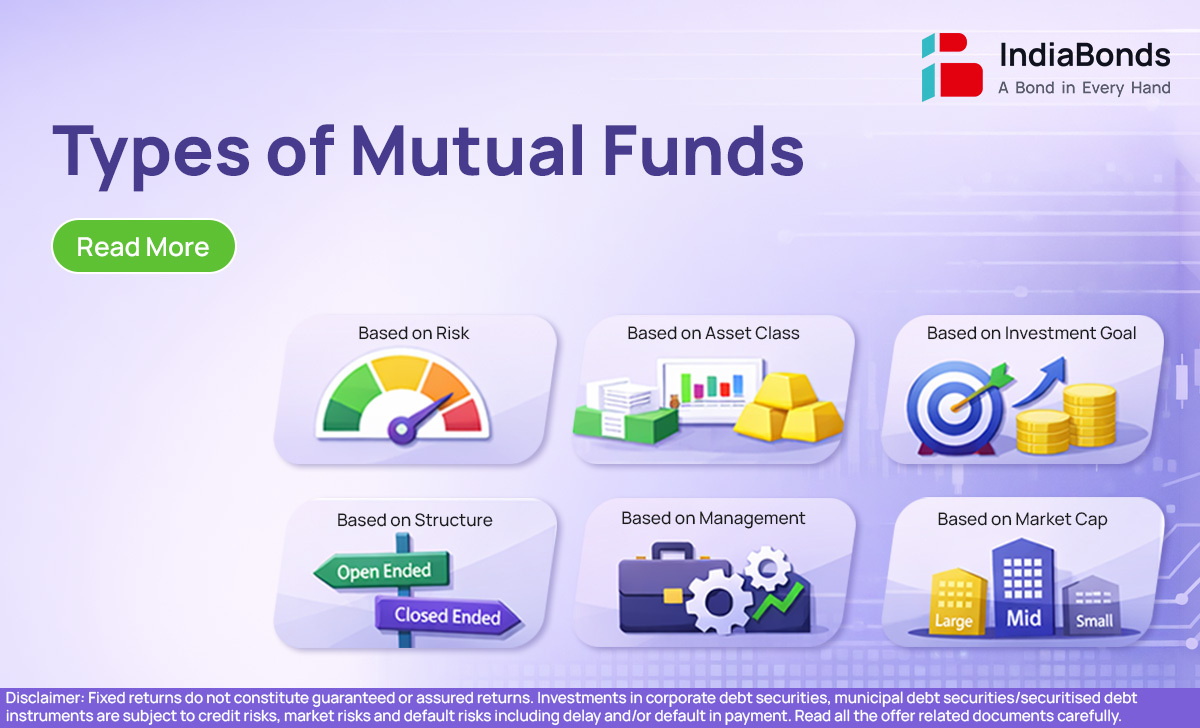
Open a list of mutual fund schemes and it’s normal to feel overwhelmed. There are hundreds of options, and the names don’t always tell you what you’re actually signing up for. The good news is that all the different types of mutual funds follow a basic logic: every fund invests in something specific, for a specific purpose, with a specific structure. Once you see how funds are grouped, the list stops feeling random. You stop asking “which fund is famous right now” and start asking “which type actually fits my goal.” That shift makes the whole exercise a lot easier.
Different Types of Mutual Funds in India
SEBI, India’s market regulator, has put mutual funds into defined categories so investors can compare like with like. A large-cap fund in one fund house has to follow the same rules as a large-cap fund in another. This consistency makes the different types of mutual funds in India more navigable than they appear at first glance.
Three questions help you cut through the categories quickly. First, what does this fund invest in — shares, bonds, or a mix of both? Second, how can you enter and exit — on any business day, or only during a fixed window? Third, who is making the decisions — a fund manager actively picking stocks, or an algorithm tracking an index?
When you sort funds by these three things, the types of mutual funds in India stop feeling like one big undifferentiated list. You’re choosing between a handful of meaningful categories, each designed to serve a clear purpose.




Mutual Fund Types Based on Risk
Risk isn’t a warning label. It describes how much your investment’s value can move, and how uncomfortable that might feel on a bad month.
The types of mutual funds based on risk, broadly:
- Lower risk: Short-term debt funds. Usually chosen for stability and easy access, not big returns.
- Moderate risk: Diversified equity or balanced hybrid funds. These can grow, but they don’t swing as sharply.
- Moderately high risk: Mid-cap and aggressive hybrid funds. These can move quickly, in both directions.
- High risk: Small-cap and sector funds. Can be rewarding over long periods but test patience during downturns.
A practical self-check: if you might need this money in the next one to two years, staying in high-risk categories usually isn’t worth the volatility.
Mutual Fund Types Based on Asset Class
What a fund owns is the most fundamental way to understand it.
- Equity funds: Mainly shares. Best for goals with a longer runway because markets can be volatile in the short run.
- Debt funds: Bonds and money market instruments. Usually chosen for steadier, more predictable movement.
- Hybrid funds: A mix of equity and debt. Useful when you want some growth without going fully into equities.
- Gold funds / ETFs: Used for diversification, not as a primary growth engine.
When you’re stuck, choose by the job: growth (equity), stability (debt), or balance (hybrid).
Mutual Fund Types Based on Investment Goals
The right question isn’t “which fund is performing well right now?” It’s “what is this money for?”
- Long-term goals like retirement or wealth creation: Equity-oriented funds, because time is on your side.
- Stability-focused goals: Debt-oriented funds, where sharp capital swings aren’t welcome.
- Tax planning under Section 80C: ELSS funds, which come with a three-year lock-in period.
- Short-term money parking: Liquid or overnight funds for amounts you might need within a few months.
A clear goal makes it much easier to filter out fund types that don’t belong in your plan.
Types of Mutual Funds Based on Structure
Structure is about access — how and when you can put money in or take it out.
- Open-ended funds: You can buy and sell on most business days at the current NAV. Most mutual funds in India are open-ended.
- Close-ended funds: These run for a fixed tenure. You invest during the launch window and get your money back at maturity. Some are listed on stock exchanges for early exit.
- Interval funds: Open for transactions only during specific time windows.
If flexibility matters most to you, open-ended schemes keep things simple. If you’re comfortable with a fixed investment horizon, close-ended options may suit.
Types of Mutual Funds Based on Portfolio Management
Management style is essentially the fund’s decision-making personality — and it affects costs too.
- Actively managed funds: A fund manager decides what to buy and sell, aiming to beat a benchmark. This typically costs more in terms of expense ratio.
- Passive funds (index funds / ETFs): The fund tracks an index and doesn’t try to outperform it. Lower costs and simpler, more predictable behaviour.
- Factor / rule-based funds: These follow defined screens like quality, low volatility, or momentum, instead of relying on a manager’s discretion.
If you prefer a hands-off, cost-efficient approach, passive funds are worth a closer look. If you believe a specific manager’s process adds real value, active funds can make sense.
Types of Mutual Funds Based on Market Capitalisation
Market cap categories apply mainly to equity funds and give you a sense of how a fund may behave.
- Large-cap funds: India’s 100 largest listed companies. Generally less volatile than smaller segments.
- Mid-cap funds: Companies ranked 101 to 250 by market cap. Higher growth potential, sharper swings.
- Small-cap funds: Companies ranked 251 and beyond. Can be very rewarding over the long term, but test patience during downturns.
- Flexi-cap / Multi-cap funds: Mix across company sizes, giving the manager flexibility to shift allocation.
If you’re starting out, jumping straight into small-cap heavy types of mutual funds can be a rough introduction to equity investing.
Types of Mutual Funds Based on Risk
Beyond the broad risk buckets, it helps to understand what kind of risk you’re taking. Different types of mutual funds carry different flavours of risk.
- Market / equity volatility: Share prices change daily.
- Credit risk: A bond issuer can face financial stress, affecting the NAV of some debt funds.
- Interest-rate risk: Bond prices tend to fall when interest rates rise.
- Concentration risk: Sector and thematic funds depend heavily on one theme or market cycle.
- Liquidity risk: Some holdings may be harder to sell quickly without a price cut.
Two debt funds can behave very differently depending on which of these risks they carry. Reading the fund’s risk-o-meter and Scheme Information Document gives you the full picture.
Specialised Mutual Funds
Specialised types of mutual funds are concentrated bets. They can work well in the right context, but they need to be used carefully.
- Sector funds: One sector only — banking, pharma, IT, etc. Rewarding when that sector’s cycle is favourable, painful when it’s not.
- Thematic funds: Built around an idea like manufacturing, consumption, or ESG. Still quite concentrated.
- International funds: Add global exposure but also bring in currency risk and global market volatility.
- Gold funds / ETFs: Useful for diversification, especially during equity market stress.
These types of mutual funds generally work better as a smaller part of a portfolio, not the entire plan.
Solution Oriented Mutual Funds
These types of mutual funds are designed around specific life goals and usually come with a lock-in period.
- Retirement funds: Aimed at building a long-term corpus. Lock-in is until the age of 58, or five years from the date of investment, whichever is earlier.
- Children’s funds: Built for education or other future expenses. Five-year lock-in, or until the child turns 18.
These can be helpful if having an investment assigned to a specific purpose keeps you committed. Still, check the equity-to-debt ratio and lock-in terms before investing.
Taxation Rules Based on Mutual Fund Types in India
Tax treatment varies across types of mutual funds. It depends on the fund category, your holding period, and the rules in effect when you buy and sell. Treating tax as a deciding factor upfront can lead to poor fund choices. It’s better to treat it as one input among several.
- Equity-oriented funds: Gains held for more than one year are long-term capital gains, taxed at 12.5% above ₹1.25 lakh. Short-term gains (held under a year) are taxed at 20%.
- Debt-oriented funds (purchased after April 1, 2023): Taxed at your applicable income tax slab rate, regardless of holding period.
- Dividends: Added to your taxable income and taxed at your slab rate.
Tax rules do change. Verify the current provisions before finalising any investment, especially in debt funds where rules have been revised in recent years.
Choosing the Right Type of Mutual Fund for Investment
Start with your goal and time horizon. Pick a risk level you can genuinely live with during bad markets, not just on paper. Avoid overcomplicating the portfolio. One or two sensible categories, invested in consistently, tend to work better than frequent switching across types of mutual funds based on short-term performance.
Points to Consider Before Investing
Before investing, confirm:
- The fund’s category fits your goal and timeline
- The expense ratio and exit load are reasonable for the category
- You understand the type of risk involved — credit, interest rate, or market volatility
- You’ve decided whether to invest via SIP or lump sum
- Your KYC, nominee, and bank details are current
How to Invest in Mutual Funds Through Bonds Interest
If you hold bonds and receive regular coupon payments, those payouts don’t have to sit idle in a savings account. Route the coupon income into a SIP instead. An equity fund SIP works well if the goal is long-term compounding. A conservative hybrid or short-duration debt fund works better if stability matters more. This approach uses your bond interest as a monthly investment engine — you get the predictability of bond cash flows and the gradual market participation of a mutual fund SIP, both working together.
Conclusion
The different types of mutual funds in India look complex mainly because there are many categories, not because the concept is hard to grasp. Equity, debt, and hybrid funds each serve different purposes. Specialised and solution-oriented types have their place, but shouldn’t form the bulk of most portfolios. The real advantage comes from choosing the right type for your goal and staying invested through market cycles, rather than switching funds every time another category looks more attractive. Clarity about purpose is what turns a decent fund selection into a successful investment.
FAQs
Q1. What type of mutual fund is best?
There’s no single best type. The right choice depends on your goal, time horizon, and how much volatility you can handle. Equity for long-term growth, debt for stability, hybrid for balance.
Q2. How many types of funds are there?
SEBI has defined 36 mutual fund categories across equity, debt, hybrid, solution-oriented, and other schemes.
Q3. How do I start a mutual fund?
Complete your KYC, choose a fund category that fits your goal, and invest via SIP or lump sum through a registered platform.
Q4. Which type of mutual fund is safest?
Liquid and overnight funds are the most stable. They invest in very short-term instruments and carry limited market risk.
Q5. Which mutual fund is good for 5 years?
For a five-year horizon, diversified equity funds or balanced advantage funds are common choices, though the best option depends on your specific goal and risk appetite.
Q6. What are different categories in mutual fund?
The main categories are equity, debt, hybrid, solution-oriented (retirement and children’s funds), and other funds like index funds and fund-of-funds.
Q7. What is the most common type of mutual fund?
Open-ended equity and hybrid funds are the most commonly invested types in India, largely due to their flexibility and growth potential over longer horizons.
Disclaimer : Fixed returns do not constitute guaranteed or assured returns. Investments in corporate debt securities, municipal debt securities/securitised debt instruments are subject to credit risks, market risks and default risks including delay and/or default in payment. Read all the offer related documents carefully.
1.56K