

Download IndiaBonds App
400K+ Downloads

 Search


What is a Forward Contract?
 592
592
Introduction
In everyday life, people make small informal “forward contracts” all the time without calling them that.
A shopkeeper might agree today to supply sweets for a wedding next month at a fixed rate.
A landlord may lock in the rent for the next year.
A farmer might promise a local trader a part of the coming harvest at a price discussed in advance.
In finance, a Forward contract is simply this same idea, written more formally and used with money, commodities, interest rates or currencies. The world around is full of changing prices. Businesses, farmers, exporters and traders know that one sudden move in price can disturb months of planning. A forward contract gives them something steady to hold on to.
It is not a flashy product. It does not appear in headlines every day. But quietly, in the background, it lets two parties say to each other, “Whatever happens in the market, our price is fixed.”
What is Forward Contract
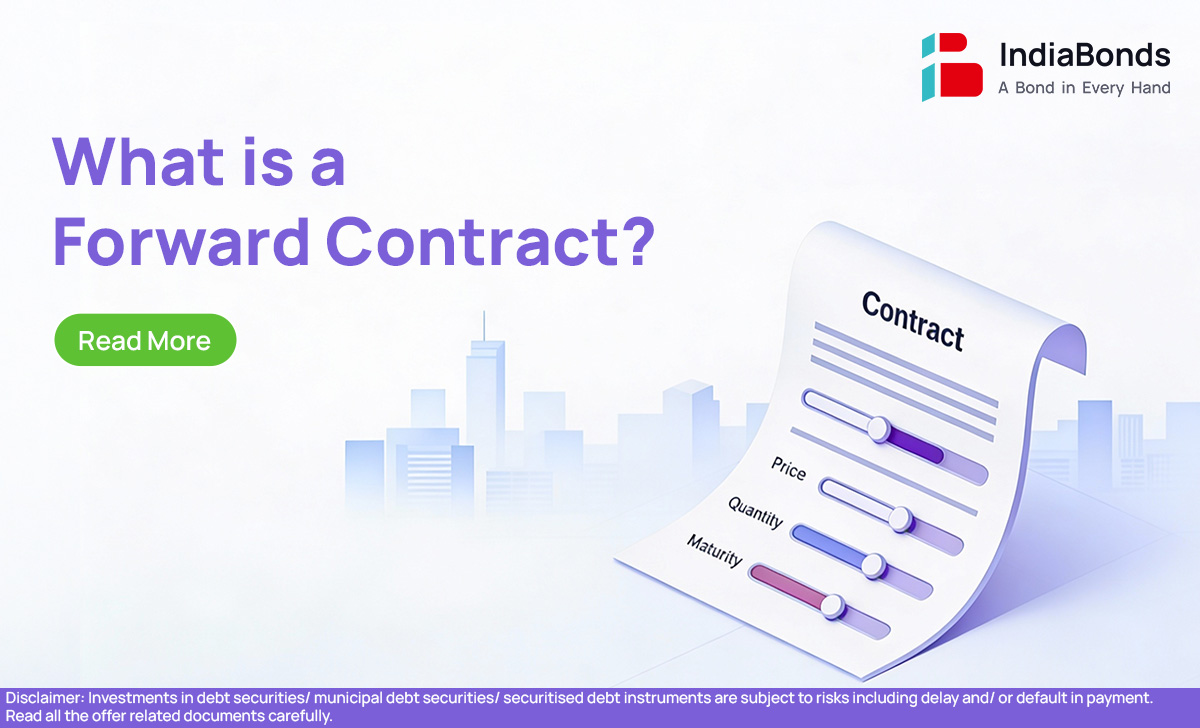
A Forward contract is a private agreement between two parties to buy or sell an asset at a fixed price on a future date. The asset could be wheat, sugar, gold, crude oil, US dollars, company shares or even an interest rate.
Both parties decide three key things:
- the underlying asset,
- the price at which it will be exchanged, and
- the future date on which the exchange will happen.
This agreement is not traded on an exchange. It is usually negotiated over the counter, often with the help of a bank, broker or dealer. Because it is tailor-made, each forward contract may look slightly different. Size, maturity, quality and settlement method are all flexible.
At its heart, the contract is simply a promise. One party promises to buy, the other promises to sell, and both rely on that promise when planning their future cash flows.




Features of Forward Contract
A Forward contract has some distinctive features that separate it from other market instruments:
- Customisation – Every term can be adjusted. The parties may choose any quantity, any date and any price that suits their situation.
- Over-the-counter nature – It is an OTC contract, not an exchange-traded one. The details remain between the parties and any intermediary helping them.
- No daily settlement – Unlike some derivatives, there is no mark-to-market every day. Profit or loss is realised only on the settlement date.
- Limited liquidity – Because each contract is unique, it is not always easy to pass it on to someone else.
- Counterparty risk – There is always a chance that one party may fail to honour the promise. This credit risk is a key feature of forward contracts.
- Use in hedging and speculation – Many participants use a Forward contract to hedge, while some take positions purely on expectations of future prices.
These features together explain why the features of forward contract are often discussed separately in risk-management conversations.
Understanding Forward Contract
To really understand a Forward contract, it helps to imagine the worries sitting in the minds of people who use it.
A farmer looks at a field full of standing crop. The crop is healthy, the monsoon has behaved, but one thought keeps returning: “What if prices crash by harvest time?”
An exporter has shipped goods and expects to receive dollars three months later. The payment is sure, but the rupee–dollar rate is not. A small movement could erase a large part of the profit.
A jeweller plans a festive-season collection. Designs are ready, workers are lined up, but gold prices are moving up and down every week.
In all these cases, the person is not trying to “beat the market”. The need is simpler: predictability. A Forward contract gives exactly that. By fixing a price today, it turns an unknown future into a known one. After that, the person can plan calmly – whether it is farm expenses, export margins or jewellery pricing.
Applications of Forward Contract
Because price uncertainty appears in many forms, applications of a Forward contract are wide:
- Commodities – Farmers, cooperatives, mill owners and commodity traders use forward contracts on crops, metals or energy products to lock in selling or buying prices.
- Currencies – Importers and exporters rely on currency forward contracts so that a future payment or receipt in foreign currency translates into a known amount in local money.
- Interest rates – Banks and corporates may enter forward rate agreements to stabilise future borrowing or lending costs.
- Corporate planning – Companies with global operations use forward contracts to match future cash flows with future expenses.
- Investment strategies – Some market participants use forward positions to express a view on the direction of prices without holding the physical asset.
In each case, the applications of forward contract revolve around the same idea: reduce the impact of unwanted price moves.
Trading Principles of Forward Contract
Although every Forward contract is customised, trading in such contracts broadly follows a few simple principles:
- Mutual consent – No template is imposed from outside. The buyer and seller agree on all terms through discussion and negotiation.
- Specified maturity – Every contract carries a clear settlement date.
- Fixed forward price – Once the price is agreed, it does not change, even if the market price later drifts far away.
- Obligation, not option – Both parties are bound to perform. A forward is not a “maybe”; it is a commitment.
- Settlement choice – At the time of drafting, the parties decide whether the contract will end with physical delivery of the underlying asset or with a cash-settled difference.
These trading principles of Forward contract allow parties to know exactly what they are signing up for, long before the settlement day arrives.
Mechanics of Forward Contract
The mechanics of a Forward contract are easier to follow when seen as a timeline:
Need is identified
A business, farmer or investor realises that a future price could hurt their position. They feel the need for protection or for a structured exposure.
Terms are negotiated
The two sides – sometimes helped by a financial institution – discuss the underlying asset, quantity, forward price, maturity date and the kind of settlement.
Contract is documented
Once agreed, the understanding is put into a written contract. From this point on, each party uses it as a reference for planning.
Price moves in the market
During the life of the contract, the spot price of the underlying asset keeps changing. On some days, the contract favours the buyer; on others, the seller.
Settlement
On maturity, the contract is settled. If it is a physical contract, the asset is delivered and payment is made at the forward price. If it is cash-settled, only the difference between market price and contract price is exchanged.
This step-by-step mechanics of forward contract show that once the agreement is in place, everything else simply follows a pre-agreed path.
Examples of Forward Contract
A few simple examples of Forward contract make the concept clearer:
Farmer and trader
A wheat farmer expects a harvest of 10 tonnes in four months. Worried that market prices may fall, the farmer signs a contract with a grain trader to sell the crop at ₹20,000 per tonne on a fixed date. When harvest time comes, even if the spot price has dropped, the trader is still obliged to pay the agreed amount.
Exporter and bank
An exporter is due to receive USD 50,000 after three months. To avoid the risk of the domestic currency strengthening, the exporter enters a currency forward with a bank at a pre-agreed exchange rate. The future inflow in local currency becomes clear on the day the contract is signed.
Jeweller and supplier
A jeweller plans to buy gold in two months. To escape rising prices, the jeweller signs a forward contract with a bullion dealer at today’s rate. Production planning and retail pricing become far easier because the cost of gold is no longer a guess.
These examples of forward contract show how naturally the product fits into real economic activity.
Difference between forward and future Contract
A Forward contract is often mentioned in the same breath as a future contract, but the two differ on several points:
- Trading venue – A forward is an OTC contract; a future is traded on organised exchanges.
- Standardisation – Forwards are customised; futures come in standard sizes and maturities.
- Settlement style – Forwards generally settle once at maturity; futures are marked to market every day with margin requirements.
- Counterparty risk – In a forward, each party bears the risk that the other might default. In a future, a clearinghouse stands between buyer and seller and significantly reduces this risk.
- Liquidity – Futures contracts are usually more liquid and easier to exit than individual forward contracts.
Understanding the difference between forward and future contract helps a business or investor choose the more suitable tool for its needs.
Conclusion
The modern financial system often seems full of complex products, but a Forward contract is built on a very human need: the desire for certainty. When prices are unpredictable, the mind naturally looks for something firm to hold on to.
Forward contracts give that firmness. They let two parties agree today on how a transaction will look tomorrow. After that, crops can be grown, goods can be produced, exports can be shipped and budgets can be made with more confidence.
Of course, like any agreement, a forward carries risks – especially the risk that one party may fail to keep the promise. But when used thoughtfully, it becomes a powerful, quiet tool for smoothing out the rough edges of price volatility.
FAQs
What is a forward contract with an example?
A forward contract is just a deal to buy or sell something in the future at a price both sides decide today.
For example, a farmer and a trader may fix the wheat price now for delivery after harvest. When that day comes, they follow this agreed price, not the market one.
What is the difference between a forward and future contract?
A forward contract is private and flexible — the two parties set all the terms themselves, and it settles only on one final date.
A future contract is standard, traded on an exchange and settled every day through margins, with a clearinghouse in between to manage the risk.
3. What are the 4 types of derivative contracts?
The four types are forwards, futures, options and swaps.
4. Who uses forward contracts?
Farmers, exporters, importers, manufacturers, banks, traders and companies use forward contracts when they want a fixed price for the future instead of guessing what the market will do.
5. What are three examples of contracts?
Three simple examples are: a farmer fixing crop prices early, an importer locking a dollar rate before making a payment and a jeweller agreeing today on the gold price for next month’s delivery.
Disclaimer : Investments in debt securities/ municipal debt securities/ securitised debt instruments are subject to risks including delay and/ or default in payment. Read all the offer related documents carefully.
592











CIN: U67100MH2008PTC178990
SEBI Registration No.: INZ000311637
NSE Member ID - Debt Segment: 90316
BSE Member ID - Debt Segment: 6811
Caution : Beware of fraudsters and impersonators misusing the name of IndiaBonds. Always verify communications and transactions through our official website www.indiabonds.com and mobile application only. Click here for Advisory and Safety Tips.