Search


What is a Medium-Term Note
 898
898
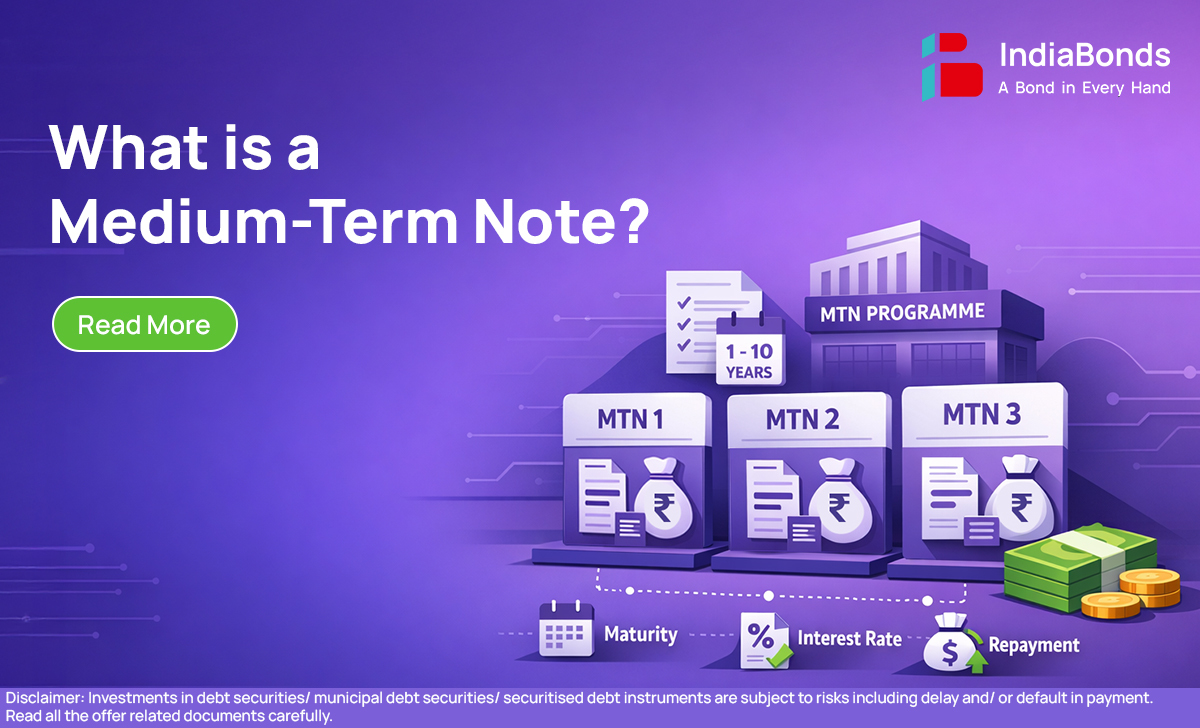
For most people, the debt market feels like a maze of similar-sounding terms. Bonds, notes, debentures—everything seems to mean “someone borrows and someone lends,” so why all the different names? The answer is simple: the market uses different formats because borrowers don’t always need money in the same way, and investors don’t always want to lend for the same time period.
This is exactly where Medium-Term Notes come into the picture. They sit in that comfortable middle zone—not too short, not too long—and they’re built for flexibility. Companies and financial institutions use Medium-Term Notes to raise funds in a more “as-needed” manner rather than doing one big issue every time. For investors, Medium-Term Notes often feel familiar because the core idea is still the same: lend money, earn interest as per terms, and receive principal back at maturity. The only difference is the way the issuance is organised.
What Is a Medium-Term Note
A Medium-Term Note is a debt instrument issued by a company or a financial institution, usually with a maturity broadly ranging from one year to ten years. That’s the “medium-term” part—longer than short-term instruments, but not stretching into decades.
If someone is asking what is a Medium-Term Note, the clean explanation is this: it is usually issued under an MTN programme, which lets an issuer raise money multiple times without creating a fresh bond issue from scratch each time.
This programme aspect is what makes Medium-Term Notes stand out. It’s like setting up a ready framework. Once the issuer has that framework in place, it can issue different Medium-Term Notes over time. Each note still has defined terms—maturity, interest/coupon structure, repayment conditions—just like a bond. But the issuer isn’t forced to treat every fund-raising need as a brand-new event.




How Medium-Term Notes (MTNs) Work
To understand how Medium-Term Notes (MTNs) work, it helps to think from the issuer’s side first. A company may not need a large lump sum on one day. It might need funds in phases—some today, some after a few months, some later in the year. If it launches a full bond issue every time, it repeats paperwork, marketing, and execution effort again and again.
So instead, the issuer sets up an MTN programme. That programme comes with standard documentation and disclosures that stay valid for a period of time. After that, the issuer can issue tranches of Medium-Term Notes whenever needed, within the overall programme limit.
Each tranche can be tailored. One tranche of Medium-Term Notes may be a 2-year issue with a fixed coupon. Another tranche might be 5 years with a floating rate. The flexibility lies in the issuer’s ability to match the instrument to market conditions and funding needs.
For investors, the experience is straightforward. They buy the Medium-Term Notes, receive interest payments as per the terms, and get principal back on maturity. The “note” format doesn’t change the basic lending relationship—it just changes how regularly and flexibly the issuer can come to the market.
Advantages of Investing in Medium-Term Notes
The advantages of Medium-Term Notes are best understood as “practical benefits,” not magical benefits.
For issuers, Medium-Term Notes make fund-raising smoother. After a programme is set up, issuing new Medium-Term Notes can be faster and less repetitive than launching standalone bond issues. It also allows issuers to time their borrowings—raising money when rates or demand look more favourable.
For investors, Medium-Term Notes can offer a useful maturity match. Many investors don’t want to lock money away for 15–20 years, but they also don’t want everything maturing in a few months. Medium-term tenures can sit well with common financial timelines—education planning, milestone expenses, or a staggered cash-flow strategy.
Another advantage is variety. Because Medium-Term Notes can come in different structures (fixed or floating), investors may find options that suit their preferences better than a single “standard” bond issue.
Exploring the Investment Options with Medium-Term Notes
When exploring the investment options with Medium-Term Notes, investors should expect both simple and complex offerings.
Some Medium-Term Notes are plain-vanilla. Fixed interest, defined maturity, clear payout schedule. These are easier to compare and easier to evaluate.
Others are structured Medium-Term Notes, where the return might be linked to a benchmark rate, an index, or a formula. These structures can look appealing at first glance, but they demand closer reading. The investor needs to know what exactly drives the payout and what scenarios could reduce returns.
So yes, the investment menu is wider with Medium-Term Notes—but the investor’s job is also clearer: focus less on the label and more on the actual terms.
Understanding Medium-Term Notes
A good way of Understanding Medium-Term Notes is to compare them with how traditional bonds are typically issued. Many bonds are launched as one-off offerings: fixed amount, fixed window, fixed terms. Medium-Term Notes, in contrast, are often issued under a programme that stays open for a period.
That difference matters in real markets because conditions don’t stay still. Rates change, liquidity shifts, and borrower needs evolve. Medium-Term Notes give issuers the ability to raise money in smaller tranches and stagger maturities rather than depending on one large issuance.
For investors, Medium-Term Notes add depth to the market. They create more choices across maturities and structures and can support a more evenly spread maturity ladder—rather than forcing everything into short-term or long-term extremes.
Conclusion
At their core, Medium-Term Notes are not complicated. They are a practical way for issuers to borrow over a medium time horizon, usually through a programme structure that allows repeated issuances. They still function like debt: investors lend money, earn interest as per terms, and receive principal back at maturity.
For issuers, the benefit is flexibility and efficiency. For investors, the benefit is choice—especially in maturity alignment and structure—provided the issuer quality and the note’s terms are understood properly. In a market that values timing and adaptability, Medium-Term Notes remain a useful and widely used instrument.
FAQs
What is the difference between medium-term notes and bonds?
Bonds are often issued as one-time offerings with fixed terms and a single issuance event. Medium-Term Notes are typically issued under a programme, allowing multiple issuances over time, often with different maturities and structures.
What are European medium-term notes?
European medium-term notes (EMTNs) are Medium-Term Notes issued under a programme designed for distribution across European and global markets, often allowing issuance in multiple currencies.
What is a term note?
A term note is a debt instrument with a defined maturity date. Medium-Term Notes are a category of term notes, generally falling within a mid-range maturity period.
What is the MTN program documentation?
It refers to the legal and disclosure framework that sets the rules, limits, issuer disclosures, and standard terms under which Medium-Term Notes can be issued. It enables the issuer to launch individual tranches without rebuilding the entire issuance structure each time.
What are the 4 pillars of trade finance?
The four pillars are commonly described as payments, financing, risk mitigation, and documentation/transaction support. In simple terms, trade finance helps money move safely, provides working capital, reduces risks like non-payment, and supports the paperwork and process that keeps trade running.
What is the purpose of MTN?
The purpose of an MTN is to give issuers a flexible way to raise funds in tranches over time, while offering investors access to medium-range debt instruments with varying maturities and structures.
Disclaimer : Investments in debt securities/ municipal debt securities/ securitised debt instruments are subject to risks including delay and/ or default in payment. Read all the offer related documents carefully. The inventories offered on the platform offer interest upto 12% returns.
898