

Download IndiaBonds App
400K+ Downloads

 Search


What is Asset Allocation
 424
424
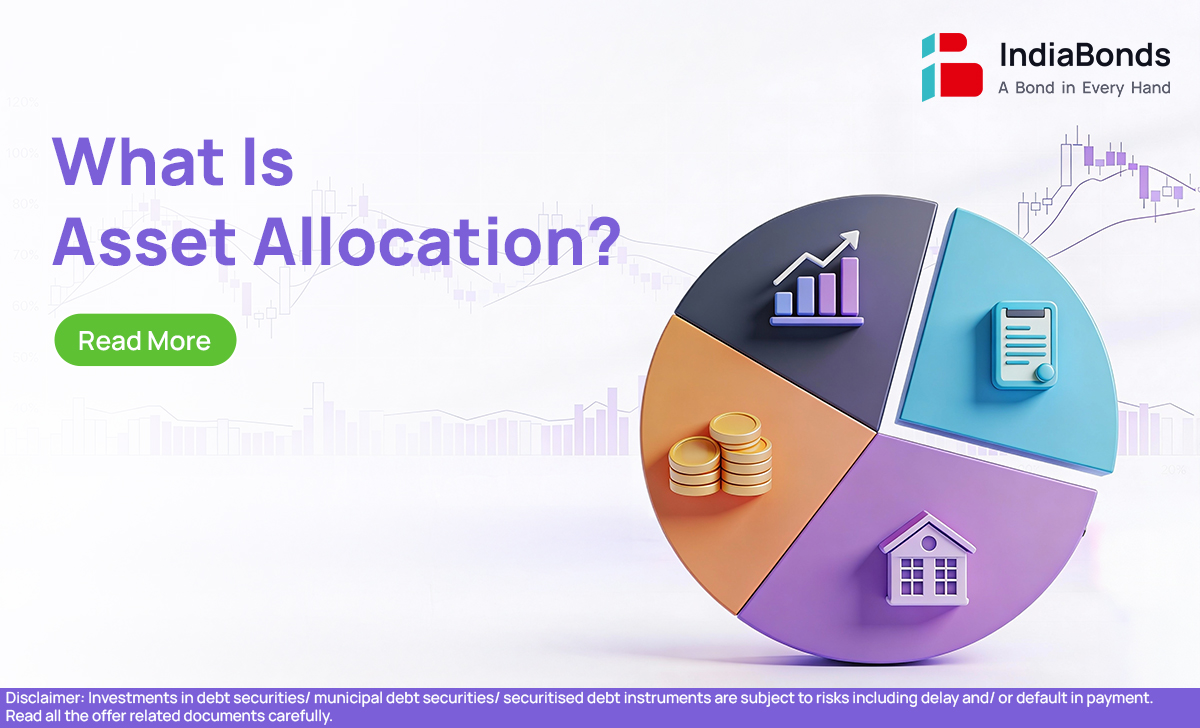
Most investors don’t lose sleep because they chose the “wrong” stock. They lose sleep because everything they own seems to fall together on the same day. That is exactly where asset allocation steps in. It is the simple practice of spreading money across different kinds of investments—so one market mood does not decide the fate of the entire portfolio. Done well, it keeps the plan steady when headlines turn loud and timelines stay real.
What Is Asset Allocation?
So, what is asset allocation in everyday language? It is the split of an investor’s money across asset classes such as equity, debt (bonds/FDs), cash, and sometimes gold or real estate. The formal asset allocation definition is “how much is invested in each asset class,” but the meaning is more practical: it decides how the portfolio behaves on a bad day and how it grows on a good one. Asset allocation is not a product; it is the framework behind the products an investor chooses.
Why Is Asset Allocation Important?
Markets rarely move in a straight line. Equity can feel exciting, but it can also feel unpredictable. Debt instruments may be steadier, but they may not always beat inflation. Gold may sometimes help during stress, but it can also sit quiet for long periods. That mix is precisely why is asset allocation important—because it acknowledges that different assets react differently to the same economic environment.
There is also a practical, human reason: behavior. When an investor’s entire portfolio is tied to a single asset class, they are more likely to make emotional moves—panic selling after a fall or overbuying after a rally. A sensible mix reduces the urge to “do something” every time the market does something. In short, asset allocation is not only about returns; it is also about staying calm enough to stick to the plan.




Factors Affecting Asset Allocation Decision
A good allocation starts with the investor’s reality, not with a template from the internet. These are common factors that shape the decision:
- Time horizon: A 20-year goal can usually handle more ups and downs than a 2-year goal.
- Goal clarity: Retirement, child’s education, home purchase—each goal has a different timeline and pressure point.
- Risk comfort: Some investors can watch markets fall and stay composed; others cannot, even if they can “afford” the fall financially.
- Cash-flow needs: If regular income is needed, the portfolio mix often leans more toward fixed income instruments.
- Interest-rate environment: Rate changes influence bond prices and future yields, so they matter for debt-heavy mixes.
- Existing exposures: Many households already carry concentrated exposure through real estate or business income; the financial portfolio often needs to balance that concentration.
The key idea is simple: allocation is personal. Two people with the same salary can still need different allocations if their responsibilities, timelines, and stress tolerance are different.
How Asset Allocation Works
Asset allocation works like a set of guardrails. First, an investor chooses the broad mix: how much in equity, how much in debt, how much in cash, and whether to add gold as a diversifier. Then comes implementation—selecting instruments inside each bucket. Debt can include government securities, high-quality corporate bonds, target-maturity funds, bank or corporate fixed deposits, and short-term options for liquidity. Equity can be direct stocks or diversified funds.
Over time, market movement shifts the weights. If equity rises sharply, it becomes a larger slice of the portfolio without the investor adding new money. If debt outperforms during a volatile period, it can quietly become the stabilizer. Rebalancing is the act of returning the portfolio to the intended mix—reducing what has become “too large” and adding to what has become “too small.” The logic is not glamorous, but it is effective: it keeps the allocation intentional instead of accidental.
Example of Asset Allocation
A clean example of asset allocation helps bring the idea to life. Consider an investor with a medium-term horizon—say 7 to 10 years—who wants growth but also wants the portfolio to remain usable if life throws a surprise.
One possible allocation could be:
- 50% Equity: for long-term growth potential
- 35% Debt: for stability and predictable cash flows
- 10% Gold: for diversification during stress periods
- 5% Cash: for immediate liquidity needs
Now imagine equity performs well for a year. The 50% could become 58%. Without any plan, the investor is now taking more equity risk than they intended—sometimes without realizing it. Rebalancing brings the mix closer to the original split. This is how asset allocation quietly prevents “drift,” which is one of the most common reasons portfolios start feeling riskier than planned.
Strategies for Asset Allocation
There are several asset allocation strategies, and they largely differ in how fixed the mix is and how often it changes. Some investors prefer simplicity; others prefer flexibility. The most common types of asset allocation include:
- Strategic (long-term) allocation: A stable mix that changes slowly as goals and life stage change.
- Goal-based allocation: Separate buckets for separate goals, each with its own time horizon and risk level.
- Core-satellite approach: A steady “core” allocation plus smaller positions for specific opportunities.
- Rule-based allocation: Changes are triggered by pre-decided rules (valuation bands, volatility bands, or time-based rebalancing).
When people ask for the best asset allocation, the honest answer is: the best one is the one aligned to the goal and simple enough to follow consistently. Complexity may look smart on paper, but consistency usually wins in real life.
Examples of Other Strategies
1. Constant-Weight Asset Allocation
Constant-weight allocation maintains a fixed proportion—such as 60% equity and 40% debt—through regular rebalancing.
- It is process-driven, not prediction-driven.
- It naturally encourages “buying low and trimming high” via rebalancing.
- It works best when the investor commits to a schedule (quarterly/half-yearly) or a band (rebalance when weights drift beyond a set range).
2. Tactical Asset Allocation
Tactical asset allocation allows short-term deviations from the long-term plan when an investor believes risks or opportunities have changed. The keyword here is temporary.
- The long-term mix remains the anchor.
- Tactical tilts may respond to valuation, earnings cycle, rate outlook, or volatility conditions.
- Without discipline, this can slip into frequent market timing, which often increases costs and mistakes.
3. Insured Asset Allocation
Insured allocation is designed to protect a minimum portfolio value—often referred to as a “floor.” If markets fall, the allocation shifts toward safer assets to preserve that floor.
- It is commonly used by investors who worry about large drawdowns.
- The trade-off is that in strong bull markets, the portfolio may participate less aggressively because protection remains a priority.
- It suits investors who value stability over chasing every rally.
4. Dynamic Asset Allocation
Dynamic asset allocation changes the mix more actively based on market conditions and/or an investor’s evolving situation. Some approaches use rules (valuation, volatility, or trend), while others rely on professional judgement.
- It aims to reduce risk when conditions look stretched and increase exposure when risk-reward looks favorable.
- It can help manage extreme cycles, but frequent shifts can also lead to churn if not governed well.
- The strength of dynamic allocation is flexibility; its weakness is that flexibility without a framework becomes inconsistency.
Conclusion
Asset allocation is the quiet architecture of investing. It does not promise perfection, but it reduces the chance that one bad phase derails the entire plan. There is no single best asset allocation strategy for everyone, but strong allocations tend to share three traits: they match the goal timeline, they respect the investor’s risk comfort, and they are easy enough to maintain through market noise.
FAQs
How Do Economic Changes Affect Asset Allocation Strategies?
Economic shifts—like inflation, changing interest rates, currency movement, or growth slowdowns—can alter how asset classes behave. Rising rates can pressure bond prices in the near term but improve reinvestment yields over time. High inflation can reduce the real value of cash and fixed payouts. Slowdowns can affect corporate earnings and equity sentiment. Many investors respond not by abandoning their mix, but by rebalancing and ensuring the allocation still matches the goal timeline.
What Is an Asset Allocation Fund?
An asset allocation fund is a fund that invests across multiple asset classes—typically equity and debt, and sometimes gold—inside one vehicle. The fund manager maintains the allocation within stated ranges. For some investors, this simplifies diversification and rebalancing because the fund handles it internally. However, it still carries market risk, and outcomes depend on the fund’s mandate, costs, and the manager’s approach.
What Is a Good Asset Allocation?
A good allocation is one that makes sense for the investor’s goal and time horizon—and that the investor can stick with during volatility. For short-term needs, higher liquidity and stability may matter more. For long-term goals, a growth component may be more relevant. The allocation is “good” if it is realistic, balanced, and aligned to the investor’s ability and willingness to tolerate fluctuations.
What Is the Best Asset Allocation Strategy for My Age?
Age can be a useful starting point because it often correlates with time horizon, but it is not a complete answer. Two investors of the same age can have very different responsibilities, income stability, and goals. Generally, longer horizons can support higher growth exposure, while shorter horizons often need more stability and liquidity. The best approach is one that fits the investor’s timeline and risk comfort—not age alone.
How Does Behavioral Finance View Asset Allocation?
Behavioral finance assumes investors are not robots. They chase recent winners, fear recent losses, and react to headlines. Asset allocation acts like a behavioral tool: it creates structure, reduces concentration risk, and encourages rebalancing instead of impulsive buying or selling. In practice, a sensible allocation often helps investors avoid the most expensive mistakes—panic exits and performance chasing.
Disclaimer : Investments in debt securities/ municipal debt securities/ securitised debt instruments are subject to risks including delay and/ or default in payment. Read all the offer related documents carefully. The inventories offered on the platform offer interest upto 12% returns.
424












CIN: U67100MH2008PTC178990
SEBI Registration No.: INZ000311637
NSE Member ID - Debt Segment: 90316
BSE Member ID - Debt Segment: 6811
Caution : Beware of fraudsters and impersonators misusing the name of IndiaBonds. Always verify communications and transactions through our official website www.indiabonds.com and mobile application only. Click here for Advisory and Safety Tips.