Search


What is Greenshoe Option
 1.41K
1.41K
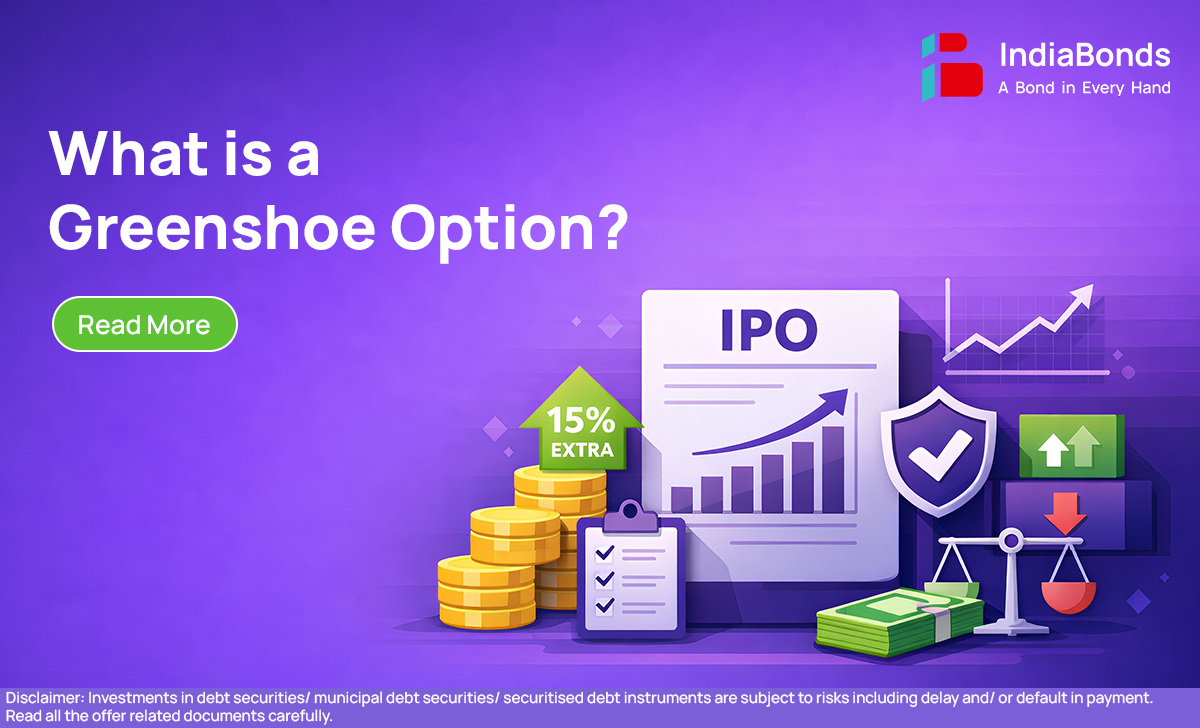
In most large public offers, there is one line in the offer document that quietly plays a big role in keeping the listing day peaceful: the Greenshoe Option. It does not grab headlines like issue size or listing gains, but it helps the market handle big demand and sharp price swings more smoothly.
What Is a Greenshoe Option
To understand the greenshoe option meaning, it helps to start with the basic definition.
A Greenshoe Option is a special arrangement in a public issue—usually an IPO—where the issuer allows the underwriters to sell more shares than the original issue size, typically up to 15% extra. This extra allocation gives underwriters the flexibility to stabilise the share price in the days immediately after listing.
In simple words, What Is a Greenshoe Option? It is an over-allotment option that permits the sale of additional shares so that the underwriters can support the price if it starts falling or meet excess demand if the issue is heavily subscribed. The name comes from the first company that used this feature, Green Shoe Manufacturing Company (now part of Stride Rite), whose deal set the template for later offers.




How a Greenshoe Option Works
The mechanics of a Greenshoe Option are straightforward once the moving parts are separated.
At the time of the offer, underwriters can allocate more shares than the base issue size, using the extra 15% cushion. To do this, they effectively create a short position by selling shares they do not yet own. After listing, two broad situations can occur:
- If the share price trades below the issue price, underwriters buy shares from the market at the lower price to cover their short position. This buying helps support the price and smoothens volatility.
- If the share price trades above the issue price and remains strong, underwriters exercise the Greenshoe Option and purchase the additional shares from the issuer at the offer price to deliver to investors.
In both cases, the option gives underwriters room to manage the after-market without distorting normal trading.
Reasons for Greenshoe
There are several reasons why issuers and underwriters include a Greenshoe Option in large public offerings.
From the issuer’s perspective, it:
- Provides flexibility to raise slightly more capital if demand is strong.
- Signals confidence that there will be sufficient buying interest, because underwriters are willing to take up the extra stabilisation role.
- Helps avoid the negative perception that can arise if the stock falls sharply immediately after listing.
From the underwriters’ perspective, the Greenshoe Option:
- Offers a tool to manage post-listing volatility without taking excessive risk.
- Allows them to support the issue price by buying back shares if the market turns weak.
- Creates room to satisfy a part of oversubscription by placing additional shares, improving relationships with institutional clients.
From the investor’s viewpoint, the presence of a Greenshoe Option brings indirect benefits:
- The price path in the first few days after listing is usually less erratic, which is helpful for both short-term and long-term investors.
- There is a perception of greater stability because a professional intermediary is actively involved in price support within regulated boundaries.
- If demand stays strong, the extra shares made available through the option mean a slightly larger free float in the market.
Put together, these reasons show why the Greenshoe Option has become a standard feature in many large, well-structured public issues around the world.
How Underwriters Use the Greenshoe Option
Underwriters do the heavy lifting when it comes to executing this mechanism. Their use of the option usually follows a clear sequence:
- Initial over-allotment
- During the offer, underwriters sell up to the allowed extra percentage of shares, creating a short position.
- Price monitoring after listing
- For a limited stabilisation period, they track how the stock trades relative to the issue price.
- Stabilisation through buying or exercising
- If the price falls, they buy shares from the market to support it and close their short position.
- If the price stays firm or rises, they exercise the Greenshoe Option with the issuer, obtain extra shares at the offer price and deliver them to investors.
These steps show that the underwriters are not simply speculating; they are using a structured tool to manage supply and demand in a transparent manner.
Example of a Greenshoe Option in Action
A simple Example of a Greenshoe Option brings the idea to life.
Imagine a company planning an IPO of 10 crore shares at ₹100 each. The underwriters negotiate a 15% Greenshoe Option, allowing them to sell up to 11.5 crore shares.
During the book-building process, demand is strong, so the underwriters allocate the full 11.5 crore shares, short-selling the extra 1.5 crore.
- If, after listing, the stock slips to ₹95, underwriters can buy back up to 1.5 crore shares from the market at ₹95 and return them to cover the short position. This buying helps support the price and limits further downside.
- If the stock trades at ₹120 and remains firm, underwriters exercise the Greenshoe Option and buy 1.5 crore new shares from the company at ₹100. They use these to settle the short position, while the issuer collects additional capital.
In both outcomes, the Greenshoe Option has helped balance the interests of the issuer, underwriters and investors.
Full, Partial, and Reverse Greenshoe
Market practice has evolved to include different Types of Greenshoe Options. The three common variants are:
- Full Greenshoe
- Underwriters are allowed to exercise the entire over-allotment (for example, the full 15%).
- This is the standard structure, providing maximum flexibility to stabilise price and manage demand.
- Partial Greenshoe
- Only a part of the permitted over-allotment is used.
- This can happen if market conditions are stable and the full volume of additional shares is not required.
- Reverse Greenshoe
- In a reverse arrangement, underwriters receive the right to buy shares from investors at or below the offer price during the stabilisation period and sell them back to the issuer.
- This format is useful when the issuer prefers to absorb shares in a weak market rather than allow the price to drift down excessively.
Together, these structures show that there is no single template; instead, the Types of Greenshoe Options are tailored to the needs of the transaction and the regulatory framework of the market.
SEC Regulations on Greenshoe
In markets like the United States, the Greenshoe Option operates within a clear regulatory framework set by the Securities and Exchange Commission (SEC). The SEC treats stabilisation activities and over-allotments as sensitive areas because they can influence prices.
To manage this, underwriters must disclose the presence and size of the Greenshoe Option in the prospectus. There are rules on:
- How much over-allotment is permitted (typically up to 15% of the base issue).
- The time window during which stabilisation purchases can be made.
- The level at which stabilising bids may be placed, usually not above the offer price.
These disclosures and limits are meant to ensure that stabilisation supports orderly markets rather than artificially inflating prices. For investors reading a prospectus, the mention of a Greenshoe Option therefore signals that post-issue price management will happen within defined, transparent boundaries.
Conclusion
The Greenshoe Option might sound like a technical footnote in an offer document, but it plays an important role in modern capital markets. It offers issuers a way to raise a little extra capital, gives underwriters a disciplined tool to stabilise prices and indirectly protects investors from extreme volatility immediately after listing.
By understanding the greenshoe option meaning, the main types of structures and how regulations frame its use, an investor gains a clearer picture of what really happens behind the scenes in a large public issue.
FAQs
What Does a Greenshoe Option Mean for Investors?
For investors, a Greenshoe Option means that professional underwriters have some room to stabilise the stock price after listing. This does not guarantee profits or prevent all volatility, but it reduces the chances of disorderly price moves in the early days of trading.
Why Is It Called Greenshoe Option?
The term comes from Green Shoe Manufacturing Company, the first firm whose public offering used this over-allotment feature. Over time the mechanism became widely adopted, and the name “Greenshoe Option” stayed on as industry shorthand.
What Are the Types of Greenshoe Options?
The main Types of Greenshoe Options are full, partial and reverse. A full Greenshoe uses the entire permitted over-allotment, a partial Greenshoe uses only a portion, and a reverse Greenshoe allows shares to be bought from investors and sold back to the issuer to support the price.
What Is the Maximum Number of Shares Allowed in a Greenshoe Option?
In many markets, including those following SEC practice, the typical cap on a Greenshoe Option is up to 15% of the base issue size. The exact limit is always specified in the prospectus so that investors know how many additional shares may be used for stabilisation.
Disclaimer : Investments in debt securities/ municipal debt securities/ securitised debt instruments are subject to risks including delay and/ or default in payment. Read all the offer related documents carefully. The inventories offered on the platform offer interest upto 12% returns.
1.41K