Search


What is Interpolation?
 2.16K
2.16K
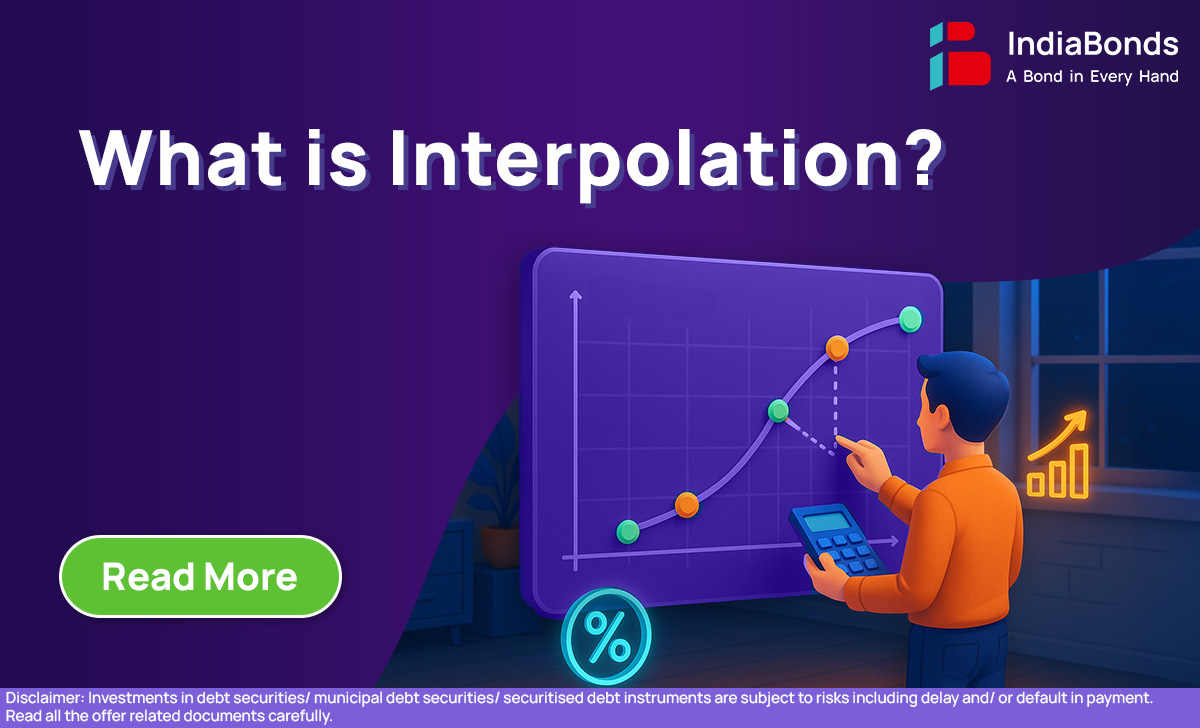
Markets move every minute but our data points are not always complete. Interpolation helps fill the small gaps. It estimates values that fall between two known points on a chart. Used well, Interpolation gives a clean line to judge prices, yields, and trends without guessing blindly.
What Is Interpolation
Let us answer what is Interpolation in the simplest way. Imagine you know the ten year government bond yield and the twelve year yield, but not the eleven year yield. Interpolation uses the two known numbers to estimate the value in the middle. That is the clean essence. If you still ask what is Interpolation, think of it as drawing a neat line between two dots and then reading any point on that line. The Interpolation meaning in finance is an estimate inside the observed range. A short Interpolation definition is an informed method to compute missing values that lie between known data points. It is not a guess in the dark. It is a rule based estimate that respects the shape of the data you already trust.
How Interpolation Works
To grasp what is Interpolation, picture two points on a graph. You connect them with a line or a curve. Then you read the value at any position between those two points. That reading is your Interpolation. The easiest approach is linear Interpolation, where we assume the change from the first point to the second point is even and straight. There are also curve based methods that bend the line gently to mirror real market behaviour. In every case Interpolation keeps you inside the known range. You use it to estimate a missing yield, a fair coupon, or a price at a maturity that sits between two available maturities. The power of Interpolation lies in its calm logic.




Example of Interpolation
Here is a clear example of interpolation from the bond world. Suppose the nine year government bond yields seven point one percent and the ten year yields seven point five percent. You want an estimate for a nine and a half year security. With simple linear Interpolation, you move half the distance from seven point one to seven point five. The midpoint is about seven point three percent. That estimate can help you price a new issue or check if a traded bond looks rich or cheap.
Take a second example of interpolation. A corporate bond matures in seven years and three months. Your curve has seven year and eight year points only. Interpolation lets you blend the two numbers to get a seven year and three months level. Fund managers use this Interpolation to mark portfolios. Dealers use Interpolation to quote quick prices. Analysts use Interpolation to build spot rate and zero curves. When inputs are clean, Interpolation produces consistent and repeatable answers that improve day to day decisions.
Types of Interpolation Methods
There are many flavours, each with a purpose.
One, Interpolation using a straight line. This is linear Interpolation. It is fast and works well when the curve between two points is fairly smooth.
Two, step or piecewise constant Interpolation. Here the value remains the same until the next known point. It is simple but can look blocky.
Three, polynomial or cubic spline Interpolation. These bend the line gently between points to reflect real world shapes like a yield curve hump. They reduce sharp corners and make the curve smooth.
Four, monotonic or shape preserving Interpolation. This protects the curve from odd swings. It is useful when you do not want artificial bumps.
Pick the Interpolation method that matches the behaviour of your data and the decision you want to make.
How Is Interpolation Used in Trading
Traders who ask what is Interpolation soon learn it sits quietly behind many screens. Dealers build a government yield curve and then use Interpolation to estimate spot rates for missing tenors. Once they have those rates, they price corporate bonds, value interest rate swaps, and compute carry and roll down. Portfolio managers use Interpolation to estimate benchmark levels when a bond has an odd maturity. Risk teams rely on Interpolation to create smooth curves for value at risk and scenario tests. Even in everyday brokerage notes, Interpolation supports relative value calls such as this bond trades twenty basis points rich to the curve. In short, Interpolation adds order to market data and converts scattered points into a usable map.
Conclusion
Now you know what is Interpolation and why it matters. Interpolation is a disciplined way to fill gaps inside a data range. It brings clarity to pricing and analytics without stepping outside available evidence. Choose a method that fits your curve, check the inputs, and keep results in context. Used with care, Interpolation becomes a quiet but dependable tool in every investor kit.
FAQs
What is the difference between interpolation and extrapolation?
Interpolation stays within the range of known data points. Extrapolation goes beyond the last known point. Interpolation is usually safer because it relies on nearby evidence. Extrapolation is more speculative.
Drawbacks of Interpolation Method
Results depend on data quality and the chosen method. If the real curve bends while you use a straight line, Interpolation can understate or overstate values. Sudden market jumps are also hard to capture. Always sanity check the output.
What is interpolation in statistics?
In statistics, Interpolation is an estimate for a value inside the observed range of a data set. It uses a rule such as a line or a curve that connects known observations. In finance, the same idea powers yield curve Interpolation and price discovery.
Disclaimer : Investments in debt securities/ municipal debt securities/ securitised debt instruments are subject to risks including delay and/ or default in payment. Read all the offer related documents carefully.
2.16K