Search


Understanding the Mumbai Interbank Forward Outright Rate (MIFOR)
 283
283
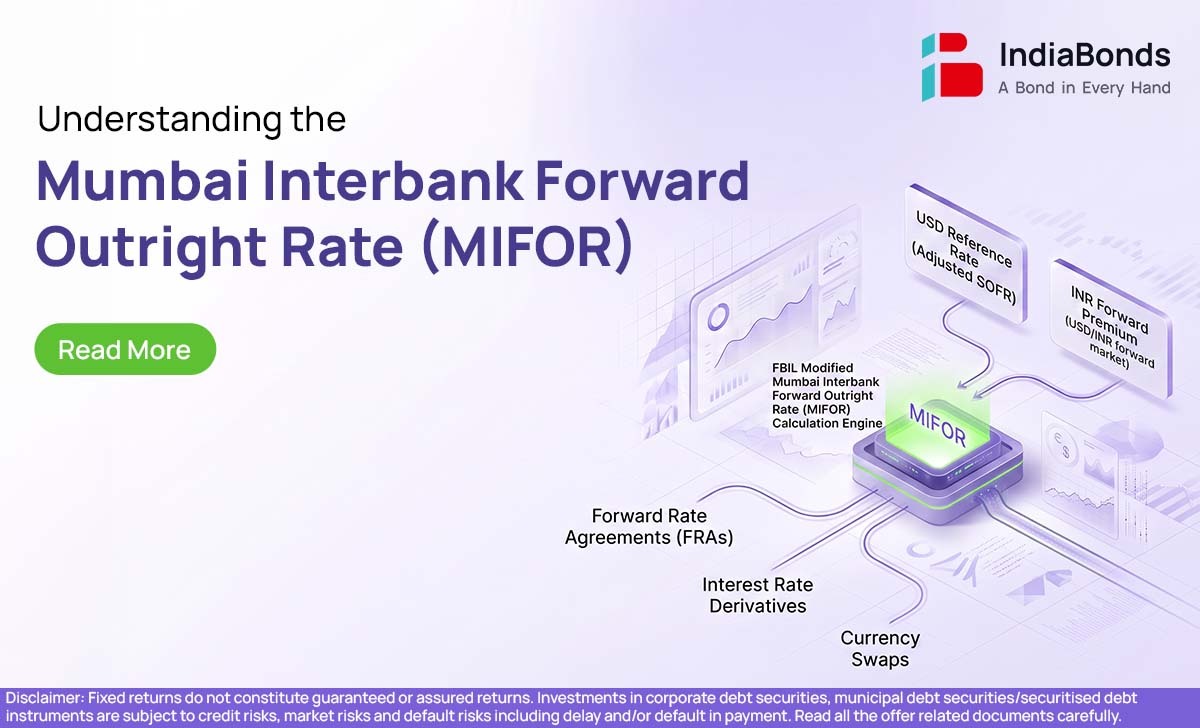
Indian banks and companies often deal with loans or derivatives that involve both rupee interest rates and foreign currency movements. A plain domestic benchmark may not fully capture this mix. MIFOR was created for such transactions. It combined a US dollar interest-rate benchmark with the USD/INR forward premium to produce an implied rupee interest rate.
Key Takeaways
- MIFOR Full Form is Mumbai Interbank Forward Outright Rate.
- It was an implied rupee interest-rate benchmark with a foreign-exchange component.
- Traditional MIFOR used USD LIBOR and the USD/INR forward premium.
- The original benchmark stopped being published after June 30, 2023.
- Modified MIFOR now uses SOFR-based inputs instead of LIBOR.
- It is mainly relevant to swaps, derivatives, hedging and valuation.
- MIFOR and MIBOR are not the same benchmark.
What Is MIFOR?
For someone asking what is MIFOR, it can be understood as a synthetic rupee interest rate used mainly in India’s derivative market.
The MIFOR Meaning becomes clearer after looking at its two original parts. The first was USD LIBOR, which represented a dollar interest rate for a selected tenure. The second was the forward premium or discount between the US dollar and Indian rupee.
These two inputs were combined to arrive at an implied rupee rate. Banks could then use that rate to price or value transactions involving foreign-currency borrowing and rupee cash flows.
Historically, MIFOR was published for different tenures and served as a reference for forward-rate agreements, interest-rate swaps and cross-currency transactions. FBIL describes the original MIFOR curve as an implied Indian rupee interest-rate curve derived from the USD LIBOR curve and its USD/INR Forward Premia Curve.
It was not the rate at which an ordinary retail borrower could directly take a loan. It was primarily a financial-market benchmark.




Understanding MIFOR
A company may borrow in US dollars because foreign funding appears cheaper. However, its business income may be in Indian rupees. This creates two concerns: the dollar borrowing rate may change, and the rupee may move against the dollar.
Banks often help such companies manage this exposure through swaps. MIFOR provided a rupee reference rate for pricing parts of these transactions.
In simplified terms, historical MIFOR reflected:
USD interest rate + USD/INR forward-premium adjustment
Its working can be viewed in the following steps:
- A suitable dollar interest rate was taken for the required tenure.
- The forward premium between the dollar and rupee was observed.
- Day-count and compounding adjustments were applied.
- The two components produced an implied rupee interest rate.
- That rate could be used for derivative pricing or valuation.
The foreign-exchange component is what made MIFOR different from a purely domestic money-market benchmark.
Suppose the relevant dollar rate was 4% and the annualised forward-premium effect was around 2.5%. The resulting implied rupee rate could be close to 6.5%, subject to the exact calculation method. This is only a basic illustration. The actual benchmark followed FBIL’s prescribed methodology rather than simply adding two quoted figures.
The level of MIFOR could therefore change because of:
- movements in US interest rates;
- changes in the USD/INR forward premium;
- liquidity in the foreign-exchange swap market;
- expectations about Indian and US monetary policy; and
- demand for hedging from banks and companies.
Key Changes and Advisories for Usage
The structure of MIFOR had to change because its original calculation relied on USD LIBOR. As the global financial system moved away from LIBOR, Indian market participants also needed an alternative benchmark.
FBIL developed two related rates for managing the transition:
- Adjusted MIFOR: Designed mainly as a fallback for certain legacy MIFOR contracts. It uses an all-in fallback rate made up of adjusted SOFR and a historical spread adjustment, along with the FBIL Forward Premia Curve.
- Modified MIFOR: Developed as a LIBOR-free replacement using adjusted SOFR and the FBIL Forward Premia Curve.
SOFR, or the Secured Overnight Financing Rate, measures the cost of overnight borrowing secured by US Treasury securities. It is based on transaction data rather than bank estimates.
FBIL stopped publishing the original MIFOR after June 30, 2023, following the end of the relevant USD LIBOR settings. The benchmark also ceased to be classified as a significant benchmark after that date.
Before the cessation, CCIL transitioned 2,309 cleared and participating non-cleared legacy MIFOR trades, carrying a combined notional value of ₹1,80,332 crore, to Modified MIFOR on May 26, 2023.
The transition did not make the wider concept irrelevant. Modified MIFOR remains active. FBIL began publishing a Modified MIFOR Swap Curve for two-year to five-year tenures in November 2025. It added seven-year and ten-year tenures from June 8, 2026.
A contract should not be changed merely because it contains the word MIFOR. The applicable fallback language, benchmark version, spread adjustment, fixing date and calculation agent must be checked. Legacy MIFOR, Adjusted MIFOR and Modified MIFOR can produce different results.
MIFOR vs. LIBOR vs. MIBOR
Although the names sound similar, the three benchmarks served different markets.
| Point | MIFOR | LIBOR | MIBOR |
| Full form | Mumbai Interbank Forward Outright Rate | London Interbank Offered Rate | Mumbai Interbank Outright Rate |
| Main market | Indian rupee derivatives with an FX element | International unsecured interbank borrowing | Domestic overnight call-money market |
| Currency link | Included USD/INR forward premium | Published for selected currencies | Based on Indian rupee transactions |
| Original interest-rate input | USD LIBOR | Bank funding estimates | Actual call-money trades |
| Current position | Original rate discontinued; Modified MIFOR continues | Most settings discontinued | Continues as an Indian benchmark |
LIBOR was historically an international benchmark for unsecured wholesale bank funding. Original MIFOR used a USD LIBOR input but converted it into an implied rupee rate by including the USD/INR forward premium.
MIBOR is different. It is a domestic overnight benchmark calculated from eligible transactions executed in India’s call-money market. FBIL uses actual NDS-CALL trades for the Overnight MIBOR calculation.
Modified MIFOR now connects the Indian forward-premium market with SOFR-based rates. It still contains an international and foreign-exchange element, whereas MIBOR reflects short-term domestic rupee funding conditions.
Potential Risks and Disadvantages
MIFOR-linked transactions can be difficult to understand because more than one market variable affects their value. A change in the dollar rate or USD/INR forward premium can alter the benchmark.
Basis risk may arise when the actual borrowing uses one rate while the hedge refers to Modified MIFOR. Market liquidity can also affect the cost of closing a swap before maturity. Other concerns include counterparty risk, valuation uncertainty, collateral requirements and errors in applying fallback clauses.
Benchmark transition adds another risk. Original, Adjusted and Modified MIFOR are not interchangeable. Their calculation methods and intended uses differ. Contract wording must therefore be studied carefully before a rate is replaced.
Conclusion
MIFOR was created to connect dollar interest rates, currency-forward premiums and implied rupee borrowing costs. The original LIBOR-linked benchmark is no longer published, but Modified MIFOR continues to support India’s derivative market using SOFR-based inputs. Its practical use remains specialised. Understanding the benchmark version, underlying components and contract terms is essential before interpreting any MIFOR-linked rate.
FAQs
Is MIFOR still used?
The original LIBOR-linked MIFOR stopped being published after June 30, 2023. However, Modified MIFOR continues to be used and published. FBIL expanded its Modified MIFOR Swap Curve in 2026, confirming that the replacement benchmark remains active.
What is the difference between MIFOR and MIBOR?
MIFOR contains a foreign-exchange component and was historically derived from USD LIBOR and the USD/INR forward premium. MIBOR reflects domestic overnight rupee borrowing rates based on call-money-market transactions.
What is the difference between MIFOR and SOFR?
MIFOR is an implied rupee benchmark. SOFR is a US dollar overnight secured borrowing rate. Modified MIFOR uses adjusted SOFR as one of its inputs, along with the USD/INR forward premium.
What is MIFOR?
MIFOR is the Mumbai Interbank Forward Outright Rate. It was used mainly for pricing and valuing Indian interest-rate and cross-currency derivatives. The original version used USD LIBOR, while its current replacement, Modified MIFOR, uses SOFR-based rates.
Disclaimer : Fixed returns do not constitute guaranteed or assured returns. Investments in corporate debt securities, municipal debt securities/securitised debt instruments are subject to credit risks, market risks and default risks including delay and/or default in payment. Read all the offer related documents carefully.
283