Search


What is Rolling Return – Meaning and Importance
 328
328
When investors evaluate performance, they often rely on headline numbers — 1-year return, 3-year return, 5-year return. These figures look clean and decisive. But they depend entirely on where the measurement begins and ends. Shift the start date by a few months, and the outcome may change dramatically.
This is where rolling returns offer a deeper perspective. Instead of focusing on one fixed period, rolling returns examine performance across multiple overlapping timeframes. That subtle shift in approach often changes how an investment truly appears.
What Are Rolling Returns?
To understand what is rolling return, one must first understand how traditional returns can mislead. Most performance numbers are “point-to-point.” They measure return between two specific dates — nothing more.
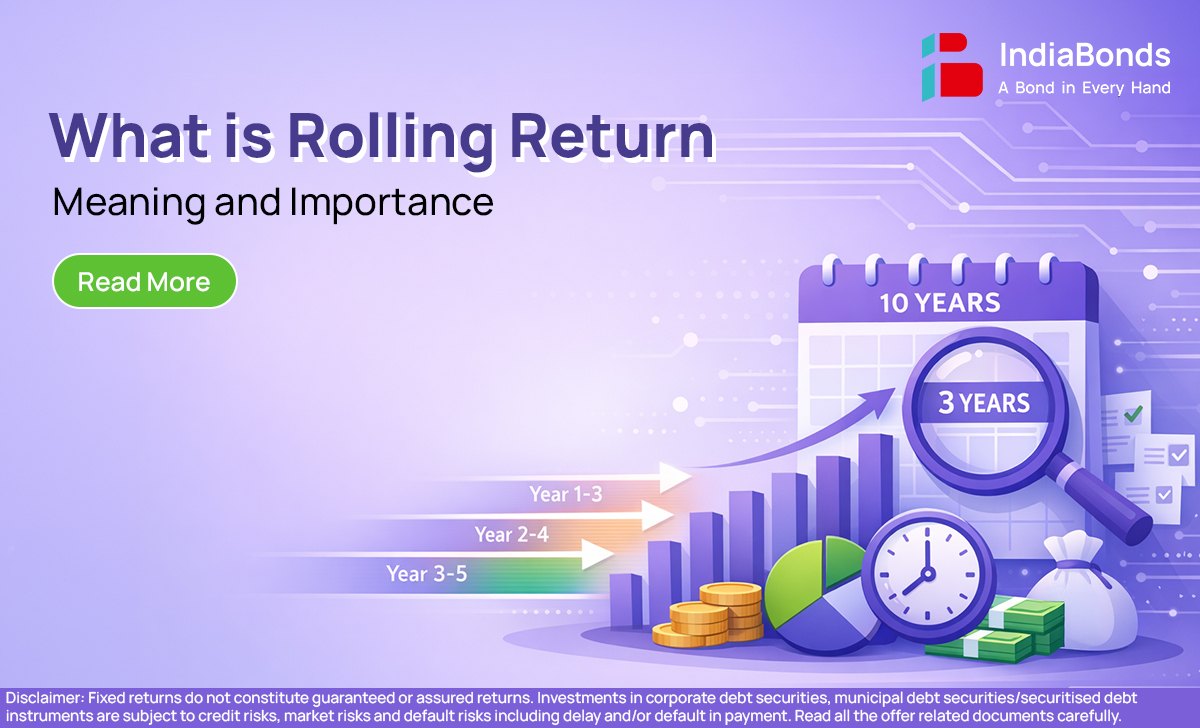
The rolling returns meaning is quite different. Rolling returns calculate returns for a fixed duration repeatedly, each time moving the starting point forward. If someone evaluates 3-year rolling returns over a 10-year period, they are not calculating one 3-year number. They are calculating every possible 3-year period within those 10 years.
For example:
- Year 1 to Year 3
- Year 2 to Year 4
- Year 3 to Year 5
And so on.
Instead of one performance figure, this method generates a series of returns. That series reveals how consistently the investment delivered across different market environments.
In simple terms, rolling returns reduce the influence of timing.




How To Analyse Rolling Returns
Analysing rolling returns requires a slight shift in mindset. Rather than asking, “How high did it go?”, the better question becomes, “How steady was it?”
Investors typically examine:
- The average rolling return
- The highest and lowest rolling return over the period
- The percentage of times returns stayed above a benchmark
Understanding how to check rolling returns is not complicated today. Many mutual fund research platforms provide rolling return charts. Investors can choose duration — 3-year, 5-year, or even 10-year — and observe performance trends visually.
What matters is not a single peak but the overall pattern.
Importance of rolling returns for mutual fund analysis
The Importance of Rolling Returns becomes particularly evident in mutual fund analysis.
Consider two funds. Both show a 5-year return of 12%. On paper, they appear identical. But when rolling returns are analysed, one fund may have delivered consistent 10–14% returns across most 5-year periods. The other may have swung from 5% to 18% depending on market timing.
That difference matters.
Rolling returns provide insight into reliability. They show how performance behaved across different entry points. This is closer to real investor experience. After all, very few investors invest on the perfect date.
For long-term investors, rolling returns often reveal whether performance strength was structural or simply cyclical.
Applications of Rolling Returns
The Applications of Rolling Returns go beyond mutual funds.
Portfolio managers use rolling returns to evaluate strategies across market cycles. Asset allocators use them to understand how equity, debt, or hybrid strategies behaved over time. Analysts rely on rolling returns to assess whether outperformance was sustained or concentrated in specific periods.
Rolling returns are also useful when comparing active funds against passive benchmarks. If a fund outperforms consistently across rolling periods, that signals more than a one-time spike.
In short, rolling returns help separate consistency from coincidence.
Analyzing the Mechanics of Rolling Returns
A practical rolling returns example makes the concept clearer.
Suppose an investor studies 5-year rolling returns from 2010 to 2020.
The calculation would include:
- 2010–2015
- 2011–2016
- 2012–2017
- 2013–2018
- 2014–2019
- 2015–2020
Each period overlaps with the previous one. Each produces a 5-year annualised return.
The result is not a single number but a timeline of returns. Some periods may show strong performance. Others may show moderation. Together, they reveal how the investment navigated different phases — bull markets, corrections, recoveries.
This mechanical structure is simple. The interpretation is where insight lies.
Utilizing Trailing 12 Months (TTM) for Financial Insights
Rolling analysis is not restricted to multi-year periods. One of the most common applications is the 12-month rolling return, often associated with Trailing 12 Months (TTM).
A 12-month rolling return calculates performance for every 12-month block within a longer period. January to December. February to January. March to February. The process continues.
This method smooths seasonal distortions and reduces the impact of unusually strong or weak months. It is especially useful when analysing shorter-term trends without overreacting to temporary volatility.
For investors tracking consistency, TTM rolling returns provide clarity without oversimplification.
Advantages of Measuring Rolling Return
There are meaningful advantages to measuring rolling returns.
First, they reduce timing bias. Investors are not dependent on one fortunate entry point to evaluate performance.
Second, rolling returns highlight consistency. A fund that maintains stable rolling returns across time demonstrates resilience across market conditions.
Third, they support better comparison. Two funds evaluated using rolling returns can be assessed more fairly than through isolated trailing returns. Finally, rolling returns often reveal volatility patterns that point-to-point returns hide. Stability, after all, is often more valuable than sporadic highs.
Limitations of Rolling Returns
Like any analytical tool, rolling returns have limitations.
- They require sufficient historical data to be meaningful.
- Longer durations reduce the number of rolling data points available.
- Interpretation may become complex when multiple durations are analysed simultaneously.
- Rolling returns are still backward-looking and do not predict future outcomes.
While rolling returns improve performance analysis, they should be complemented with risk measures such as volatility, drawdown analysis, and qualitative assessment of strategy.
No single metric tells the complete story.
Conclusion
Rolling returns change how performance is viewed. Instead of asking how an investment performed between two arbitrary dates, they ask how it performed across many entry points.
That difference is subtle but powerful.
By examining overlapping timeframes, rolling returns offer a clearer understanding of consistency, resilience, and timing sensitivity. For investors evaluating mutual funds or portfolios, this broader perspective often proves more meaningful than headline numbers.
FAQs:
What is a 5 year rolling return?
A 5 year rolling return calculates the annualised return for every possible 5-year period within a chosen timeframe. Instead of one 5-year number, it produces a series of 5-year returns across overlapping periods.
What is a rolling return example?
If 3-year returns are calculated for 2016–2019, then 2017–2020, then 2018–2021, each overlapping calculation forms part of the rolling return series.
What is a 12-month rolling return?
It measures performance for every consecutive 12-month window within a longer period, helping smooth short-term volatility.
What is a rolling 3-year return?
It represents the annualised return calculated for each consecutive 3-year block within the evaluation horizon.
Disclaimer : Fixed returns do not constitute guaranteed or assured returns. Investments in corporate debt securities, municipal debt securities/securitised debt instruments are subject to credit risks, market risks and default risks including delay and/or default in payment. Read all the offer related documents carefully.
328