Search


What is SIP? Systematic Investment Plan Benefits and Types
 2.77K
2.77K
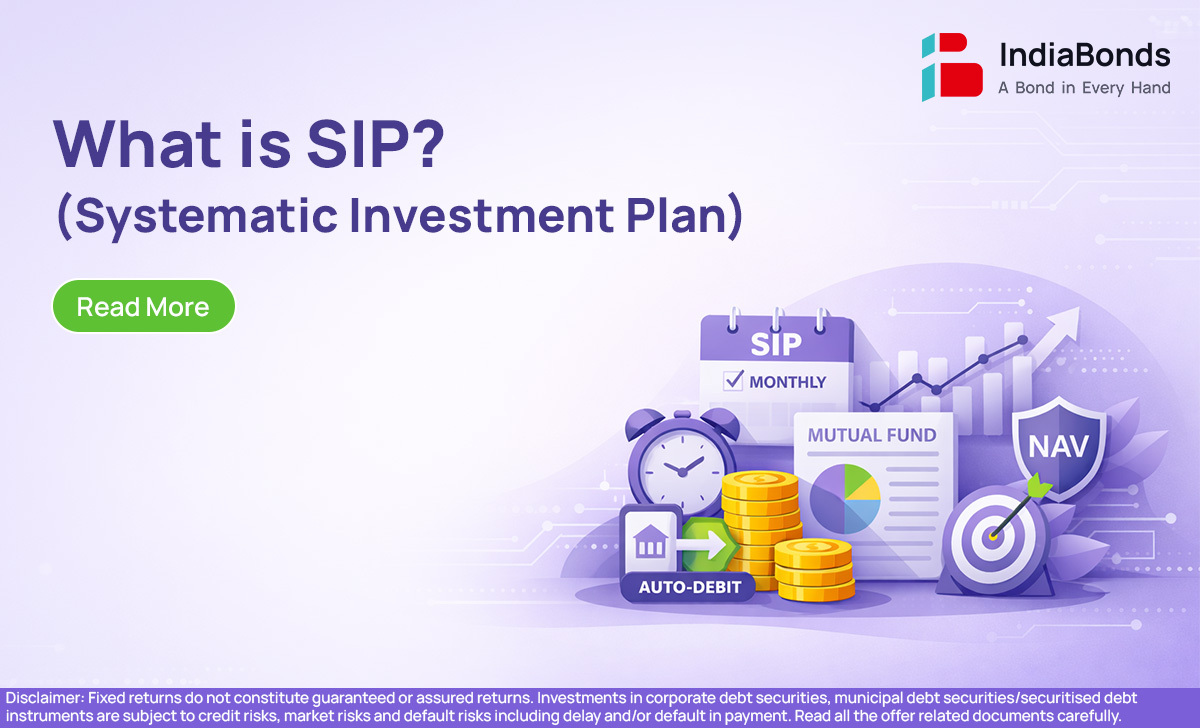
Most people put off investing not because they’re careless with money, but because they’re waiting for the right amount to accumulate. The salary gets absorbed. Expenses come up. The “right time” keeps moving. SIP — short for Systematic Investment Plan — removes that waiting game entirely. You invest a fixed amount on a fixed date, automatically, every month. No need to time the market, no pressure to gather a large starting corpus. A SIP is one of the most practical ways to build a consistent investing habit without disrupting your monthly cash flow. Whether you’re starting with ₹500 or ₹50,000, the Systematic Investment Plan works the same way: steady, automatic, and goal-directed.
What Is SIP (Systematic Investment Plan)?
A Systematic Investment Plan, or SIP, is a facility offered by mutual funds that lets you invest a fixed amount at regular intervals — usually monthly. You pick the fund, the SIP amount, and the date. After that, the amount is auto-debited from your bank account and invested at the fund’s prevailing NAV (Net Asset Value) on that day. SIP is not a product in itself. It is a method of investing in a mutual fund. The mutual fund is the product; SIP is how you invest in it. This distinction matters because people sometimes search for “the best SIP” when what they really need to choose is the right mutual fund category for their goal.
| SIP Component | What You Decide |
| Fund | Which mutual fund category suits your goal |
| SIP Amount | Fixed amount per instalment (minimum ₹100-₹500 depending on fund) |
| Frequency | Monthly is most common; weekly and quarterly also available |
| Duration | Fixed end date or open-ended (perpetual SIP) |
| SIP Date | Usually set a few days after your salary credit date |
Once your Systematic Investment Plan mandate is registered, the process is entirely automatic. You don’t have to log in or make a decision each month. The SIP does it for you.




How Does SIP Work?
Every time your SIP date arrives, the fixed amount is debited from your bank account and used to purchase units of the mutual fund you’ve chosen. The number of units you receive depends on the fund’s NAV that particular day.
Here’s what makes SIP investment interesting: NAV changes every business day. When the market is up, NAV is higher and your SIP buys fewer units. When the market is down, NAV is lower and your SIP buys more units for the same amount. Over time, this natural variation means your average purchase cost tends to smooth out. This is what’s commonly called rupee cost averaging — one of the key advantages of a Systematic Investment Plan.
You are not trying to identify the perfect entry point. You are building market participation across multiple price levels, consistently, over time.
How SIP works in practice:
- Your bank mandate authorises auto-debit on a specific date each month
- On that SIP date, the amount is debited and sent to the mutual fund
- The fund allocates units at that day’s NAV
- Your unit count grows with each SIP instalment
- Portfolio value changes daily as NAV moves, but your invested units keep accumulating
The effort required after SIP setup is minimal. Keep your bank account funded on SIP dates. Review the performance once or twice a year. That’s it.
Benefits of a SIP
The benefits of SIP investment come from its design, not from any guarantee of returns. A SIP does not promise profits. What it does is give your investing behaviour a structure that makes wealth-building much more likely over time.
- No market timing needed: Your SIP investment goes in on schedule regardless of whether markets are up or down. You remove the temptation to “wait for a better entry point” — which, in practice, often means never entering.
- Low starting amount: Many SIP investments start from ₹500 per month. You don’t need a large corpus to begin.
- Full automation: Once the bank mandate is set, the SIP runs without any manual action. No reminders, no login required.
- Builds discipline by default: The SIP invests consistently because the system makes it automatic, not because you remember every month.
- Rupee cost averaging: Buying at multiple NAV levels over time tends to smooth out your average purchase price.
- Compounding over time: The longer a SIP investment runs, the more time accumulated units have to potentially grow.
The benefits of SIP are most visible over multi-year time frames. Stopping a SIP after six months tells you almost nothing about how it would have performed.
Why Should I Invest in SIP?
The straightforward reason: most people’s wealth is built from regular income, not from one-time windfalls. A Systematic Investment Plan fits that reality. If money comes in monthly, investing monthly is sustainable in a way that investing a lump sum every year is not.
SIP investment also solves a well-documented psychological problem. Deploying a large amount of money in a volatile market is uncomfortable. Many investors hold off, wait for the “perfect moment,” and end up losing months or years of potential compounding. A SIP sidesteps that hesitation — the amount is fixed, the date is fixed, and the decision was already made when you registered the mandate.
SIP is well-suited for:
| Investor Type | Why SIP Investment Works for Them |
| Long-term goal builders | Time is the biggest compounding advantage; SIP keeps them invested |
| Salaried earners | Monthly income matches well with monthly SIP investment |
| Market-anxious investors | No need to watch NAV daily; SIP runs regardless |
| First-time mutual fund investors | Low entry barrier and automated process reduce the learning curve |
| Goal-based savers | One SIP per goal makes progress trackable and intentional |
A SIP investment won’t make markets predictable. But it makes your own behaviour predictable — which, over the long run, is often more valuable.
How Do You Get Started with SIP Investment?
Getting started with a SIP investment is straightforward. Here’s a clean sequence:
- Step 1 — Complete KYC: PAN card plus identity and address proof. Most platforms support e-KYC today, which takes under 10 minutes.
- Step 2 — Set your goal and timeline: This tells you whether an equity, debt, or hybrid SIP is appropriate. A goal in 15 years can support an aggressive equity SIP. A goal in 2 years probably cannot.
- Step 3 — Choose a fund: Not based on last month’s returns chart. Based on the category that fits your goal and the fund’s consistency over 5-10 years.
- Step 4 — Set a SIP amount you can sustain: A SIP of ₹3,000 that you continue for 10 years is worth more than a SIP of ₹10,000 that you stop after six months. Pick a number that works even during a tight month.
- Step 5 — Register the bank mandate: This links your account for auto-debit. Once active, the SIP investment runs automatically on the date you set.
After setup, you don’t need to “do” much. Review the SIP investment once a year, not every time the market moves.
Types of SIP (Systematic Investment Plans)
There are multiple types of SIP available under the Systematic Investment Plan framework, each designed for a different investor pattern or situation.
Regular SIP
The most widely used type. A fixed SIP amount is invested at a fixed frequency — usually monthly. You choose ₹5,000 per month, and that exact SIP amount gets debited every month, regardless of market conditions. Regular SIP works well for anyone who wants simplicity and consistency. Most investors in India use this type of Systematic Investment Plan as their default.
Top-Up SIP / Step-Up SIP
A step-up SIP lets you increase your SIP amount by a fixed percentage or fixed rupee amount at regular intervals — typically annually. If you start a SIP at ₹5,000 per month with a 10% annual step-up, the SIP becomes ₹5,500 in Year 2, ₹6,050 in Year 3, and continues growing. This type of Systematic Investment Plan is especially practical for salaried investors who expect salary increments. Rather than keeping the SIP flat for years, the SIP investment grows alongside your income. Over a 20-year period, a step-up SIP can build a significantly larger corpus than a flat SIP at the same starting amount.
Flexible SIP
A flexible SIP lets you change the SIP amount before each instalment, based on your cash position that month. If finances are tight, you can invest a smaller SIP amount. If you have surplus, you can increase it. Not all platforms support flexible SIP. But it can be useful for self-employed professionals or freelancers with variable monthly income, where a rigid SIP amount would cause pressure during low-income months.
Perpetual SIP
A perpetual SIP has no fixed end date. The SIP continues until you explicitly stop it. This type of Systematic Investment Plan suits investors building wealth over a long, open-ended horizon who don’t want to keep renewing their SIP every year or two. Most SIP mandates now default to perpetual unless you specifically set a maturity date. If you’re investing for retirement 25 years away, a perpetual SIP removes the hassle of renewals.
Trigger SIP
Some platforms offer a trigger-based SIP, where the SIP investment is made only when a specific market condition is met — for example, when the Sensex falls below a certain level. This type of Systematic Investment Plan tries to automate market timing. While it sounds appealing, consistent SIP investment regardless of market levels has historically worked as well or better than trigger-based approaches for most investors. Trigger SIP is available but is not a recommended default for most people.
Choosing among these types of SIP depends on your income pattern, goal duration, and how much complexity you want in your Systematic Investment Plan.
Learn SIP Through an Example
Say you run a SIP of ₹5,000 per month into an equity fund:
| Month | NAV | Units Purchased | Cumulative Units |
| Month 1 | ₹50 | 100 units | 100 units |
| Month 2 | ₹40 (market dip) | 125 units | 225 units |
| Month 3 | ₹55 (partial recovery) | ~90.9 units | ~315.9 units |
Total SIP investment: ₹15,000
Total units accumulated: ~315.9
Average cost per unit: ₹15,000 ÷ 315.9 = ₹47.48
Notice what happened without any action from you: in Month 2, when NAV fell, the SIP automatically bought more units. You didn’t need to make a decision. That’s rupee cost averaging at work.
Now if NAV recovers to ₹55 in Month 3, your portfolio value is 315.9 × ₹55 = ₹17,374.50 — on a total SIP investment of ₹15,000. This is why continuing SIP investment during market downturns is often more beneficial than pausing the SIP when things look uncertain.
Features of SIP Investment Plan
SIP investment comes with features that make it one of the most accessible wealth-building tools available to Indian investors.
- Low entry point: SIP investment starts from as low as ₹100 per month in some funds, with ₹500 being the common minimum. You don’t need a lump sum to begin. This makes a Systematic Investment Plan accessible to early-career investors.
- Full automation: Once your SIP bank mandate is in place, SIP investment requires no monthly action. Units are purchased and credited automatically on each SIP date.
- Flexibility to pause or stop: Unlike a recurring deposit, most SIP investments can be paused or discontinued without penalty. Check exit load rules if you plan to redeem investments made in the recent past.
- Complete transparency: Every SIP investment is visible in your mutual fund statement — units purchased, NAV on each SIP date, and current portfolio value. CAMS and KFintech consolidate this across funds.
- Tax benefits for ELSS SIP: If your SIP investment is in an Equity Linked Savings Scheme (ELSS), each SIP instalment qualifies for a deduction under Section 80C, up to the ₹1.5 lakh annual limit. Each SIP instalment in ELSS has its own three-year lock-in.
- Goal separation: You can run multiple SIPs — one for retirement, one for a child’s education, one for a home down payment — each tracked separately. This makes goal-based SIP investment easier to monitor.
- Portability: Your SIP investment is linked to the fund, not the platform. If you switch platforms, your accumulated units remain intact with the fund.
When to Invest in SIP?
The most common question new investors ask about SIP investment: when is the right time to start?
The short, practical answer is: when you have a clear goal, a fund category that fits that goal, and an amount you can invest every month without strain.
But there are specific situations where starting a SIP investment makes particularly strong sense.
- When you’re starting your first job: The earlier a SIP investment begins, the more time compounding has to work. Even a SIP of ₹2,000 per month started in your mid-20s can grow significantly over 25-30 years. The SIP amount matters far less than the head start in time.
- After a salary increment: Many people intend to invest their raise but end up absorbing it into lifestyle expenses. Increasing your SIP immediately after a salary hike is one of the most reliable ways to ensure that extra income gets invested rather than spent. A step-up SIP handles this automatically.
- When you have a specific goal in mind: SIP investment works best when goal-directed. A SIP for a child’s education in 15 years, a SIP for retirement in 25 years, a SIP for a home down payment in 7 years — each goal needs a different fund type and a different SIP duration. Goal clarity prevents premature SIP withdrawal.
- During periods of high market volatility: Counterintuitively, volatile markets can be a good time to continue or even start SIP investment. When NAV falls, the same SIP amount buys more units. Investors who pause SIP during downturns often miss the recovery phase — which is typically when the best unit accumulation happens.
- When you receive a bonus or windfall: While a bonus is often deployed as a lump sum, if you’re unsure about investing a large amount at once, you can use a Systematic Transfer Plan (STP) — park the bonus in a liquid fund and set up a monthly transfer to an equity fund. This mimics the effect of SIP investment for a large amount.
- When markets are at all-time highs: This is the most common reason investors delay starting a SIP. But for long-term goals, entering when markets are high is not a mistake. The point of SIP investment is to invest across market levels — highs included. Waiting for a correction that may or may not come within your planning window is a form of market timing that SIP is designed to avoid.
The one situation where SIP investment may not be the right tool: when your goal is less than two years away. For very short-term goals, a debt fund or liquid fund is more appropriate than an equity SIP investment.
Power of Starting SIP Early
Starting a Systematic Investment Plan early does not require financial expertise. It requires only a willingness to begin before you feel completely ready.
| Investor A | Investor B | |
| Monthly SIP Amount | ₹5,000 | ₹10,000 |
| SIP Start Age | 25 | 35 |
| Retirement Age | 60 | 60 |
| Years of SIP Investment | 35 years | 25 years |
Even though Investor B’s monthly SIP amount is double Investor A’s, the longer SIP investment runway typically results in a larger final corpus for Investor A. Over long periods, time is not just a marginal advantage. It is usually the deciding factor.
The power of starting SIP early is really the power of time. A SIP investment running for 35 years goes through many more market cycles than one running for 25. Each recovery after a downturn adds to the corpus. Each year of early SIP investment compounds on top of the previous year’s growth.
If you’re in your 20s: a small, consistent SIP investment started today is worth more than a larger one started in your 30s, in most long-term scenarios.
If you’re in your 30s or 40s: it’s not too late. The best time to start a Systematic Investment Plan is still now. The second-best time was earlier. Dwelling on the delay helps no one.
Who Can Benefit from Systematic Investment Plans (SIP)?
SIP investment is flexible enough to work for a wide range of investors. The Systematic Investment Plan is not a one-size-fits-all solution, but it comes close for most people building wealth through regular income.
- First-time investors who want to start without the pressure of timing the market
- Salaried professionals whose monthly income makes a monthly SIP amount natural
- Parents building a corpus for children’s education or future expenses
- Goal-based savers working towards a home purchase, retirement, or any long-term milestone
- Investors who find market volatility stressful and want a more automatic, less emotional approach
- NRIs investing in India — many SIP platforms now support NRI accounts with the appropriate mandates
- People who’ve received a windfall and want to deploy it gradually rather than all at once
One group that often underuses SIP investment: experienced investors who consider it a beginner’s tool. Many seasoned investors run SIPs precisely because the Systematic Investment Plan removes the temptation to over-trade. Discipline is not a beginner virtue — it’s useful at every stage.
How to Choose the Right SIP to Invest in India?
There is no shortage of SIP options in India. Choosing the right Systematic Investment Plan requires answering a few specific questions before looking at fund names.
- What is the goal and how long is the timeline? A SIP investment for retirement in 25 years looks very different from a SIP investment for a car purchase in 3 years. Long-term goals support equity SIPs. Short-term goals need debt or conservative hybrid SIPs.
- What level of NAV volatility can you handle? Be realistic about this. If a 30% market fall would cause you to stop the SIP, choose a lower-volatility category like large-cap or balanced advantage funds. Stopping a SIP during a drawdown is one of the most common ways investors diminish their returns.
- Direct plan or regular plan? A direct plan SIP investment has a lower expense ratio than a regular plan. Over long periods, even a 0.5% annual cost difference compounds into a meaningful gap. If you’re comfortable choosing funds independently, direct plan SIP is the more cost-efficient choice.
- Is the fund consistent over time? Look at rolling returns across 5-7 year periods, not just recent performance. A fund that has been consistently in the top half of its category over multiple market cycles is more reliable than one that dominated a single year’s chart.
- How many SIPs is too many? Three to four SIPs across meaningful categories are sufficient for most investors. Running 10 different SIPs across overlapping categories adds complexity without proportional diversification. More SIP investment accounts is not the same as better portfolio construction.
Myths About SIP Investments Explained
A few persistent myths about SIP investment come up regularly in conversations with investors:
- Myth: SIP guarantees profit. A SIP is a method, not a promise. SIP investment reduces the risk of bad market timing, but the underlying fund still depends on market performance. There is no capital guarantee with any equity SIP.
- Myth: SIP is only for beginners. Many experienced investors run SIPs for decades. The Systematic Investment Plan is a discipline framework. Whether you invest ₹1,000 or ₹1,00,000 per month, the SIP mechanism is identical.
- Myth: Stop SIP when markets fall. This is actually when SIP investment works best. A falling NAV means your SIP buys more units for the same amount. Pausing SIP during downturns removes the most valuable part of rupee cost averaging.
- Myth: Higher SIP amount always means better outcome. A higher SIP amount helps, but early start often matters more. A ₹5,000 SIP investment started at 25 typically builds more wealth than a ₹10,000 SIP investment started at 35.
- Myth: SIP locks your money in. Most SIP investments are open-ended. You can stop the SIP and redeem units at any time. An exit load of 1% may apply if you redeem equity fund units within a year, but the SIP itself does not lock your principal.
- Myth: SIP needs to be stopped during market highs. This is market timing in disguise. Long-term SIP investment is designed to run through highs and lows. Selectively stopping and restarting based on market levels undermines the core mechanism of Systematic Investment Plans.
How to Use an SIP Calculator to Invest in SIPs?
An SIP calculator helps you estimate how much a SIP investment could grow over time. You enter three inputs: the monthly SIP amount, the investment duration in years, and an assumed annual return rate. The calculator gives you an estimated future corpus.
Use the SIP calculator as a planning tool, not a prediction. Markets don’t deliver a fixed return every year, so treat the output as directional rather than guaranteed.
How to use the SIP calculator sensibly:
- Use a conservative assumed return for debt SIP (5-7% per annum) and a moderate one for equity SIP (10-12%, based on long-term historical averages, not guaranteed)
- Try different SIP amounts to understand what corpus your goal requires versus what you can currently afford
- Adjust the SIP duration to see how extending your investment by 5 or 10 years changes the end corpus — the difference is usually striking
- Use the SIP calculator to reverse-engineer: if you need ₹1 crore in 20 years and assume 10% returns, the SIP calculator will tell you what monthly SIP amount gets you there
An SIP calculator is available on most mutual fund platforms, AMC websites, and on IndiaBonds. Run the numbers before committing to a SIP amount. Understanding the potential outcome makes it easier to stay committed through market volatility.
Things to Consider Before Starting SIP
Before starting a SIP investment, a few checks worth doing:
- Have a specific reason to invest: A vague goal leads to easy quitting when markets get rough. “Retirement at 60” or “daughter’s college in 2035” is better than “wealth creation in general.” Specific goals give the SIP investment a purpose that holds through downturns.
- Choose a SIP amount you won’t stop: Sustainability matters more than size. A SIP of ₹3,000 continued for 10 years beats a SIP of ₹15,000 abandoned after three months.
- Understand the fund category: Know whether your SIP is in an equity fund, a debt fund, or a hybrid. Each category behaves differently in different market conditions.
- Check the exit load: Most equity funds apply a 1% exit load if you redeem within a year. Plan your SIP investment horizon to account for this.
- Expect bad months: A SIP investment running for several years will go through market downturns. That is not a malfunction. It is how the Systematic Investment Plan works. Downturns are when the SIP is accumulating the cheapest units.
- Review annually, not daily: Checking NAV every morning leads to anxiety-driven decisions. Annual reviews keep things in perspective and prevent unnecessary SIP switches.
Conclusion
A SIP doesn’t predict markets. What it does is make your investing behaviour consistent — which turns out to matter quite a lot over time. You invest on schedule, at multiple NAV levels, through market ups and downs, without needing to time anything. Over years, that consistency can build a meaningful corpus, especially for long-term goals. SIP investment is not designed to be exciting. It is designed to be reliable. And for most investors building wealth from monthly income, reliable is exactly what works. If you’ve been thinking about starting a Systematic Investment Plan, the decision to start today is more important than finding the perfect fund.
Frequently Asked Questions (FAQs)
What is the full form of SIP?
SIP stands for Systematic Investment Plan.
What is SIP investment?
SIP investment is the practice of investing a fixed amount in a mutual fund at regular intervals — typically monthly — through an auto-debit facility. The Systematic Investment Plan allocates units at the prevailing NAV on each SIP date.
How to start SIP?
Complete KYC, choose a mutual fund that fits your goal, set your SIP amount and date, register a bank auto-debit mandate, and the SIP investment starts automatically.
What is SIP in mutual fund?
SIP in mutual funds is the method of investing in a mutual fund scheme through equal, regular instalments over time, rather than in one lump sum. The Systematic Investment Plan is a facility, not a separate product.
Which mutual fund is best for SIP?
It depends on your goal, risk appetite, and time frame. Equity funds suit long-term SIPs. Debt or hybrid funds suit medium-term SIP investments. Consistent funds with strong 7-10 year track records in their category are generally preferred.
Is SIP safe?
SIP investment reduces the risk of poor market timing through rupee cost averaging, but there is no capital guarantee. Returns depend on the underlying fund and market performance.
How SIP works?
On each SIP date, the fixed SIP amount is debited from your bank account, invested in your chosen mutual fund at that day’s NAV, and units are credited to your account. This repeats every month until you stop the SIP.
Disclaimer : Fixed returns do not constitute guaranteed or assured returns. Investments in corporate debt securities, municipal debt securities/securitised debt instruments are subject to credit risks, market risks and default risks including delay and/or default in payment. Read all the offer related documents carefully. The inventories offered on the platform offer interest ranging from 5% to 12.2% fixed returns p.a.
2.77K