

Download IndiaBonds App
400K+ Downloads

 Search


What is Underlying?
 249
249
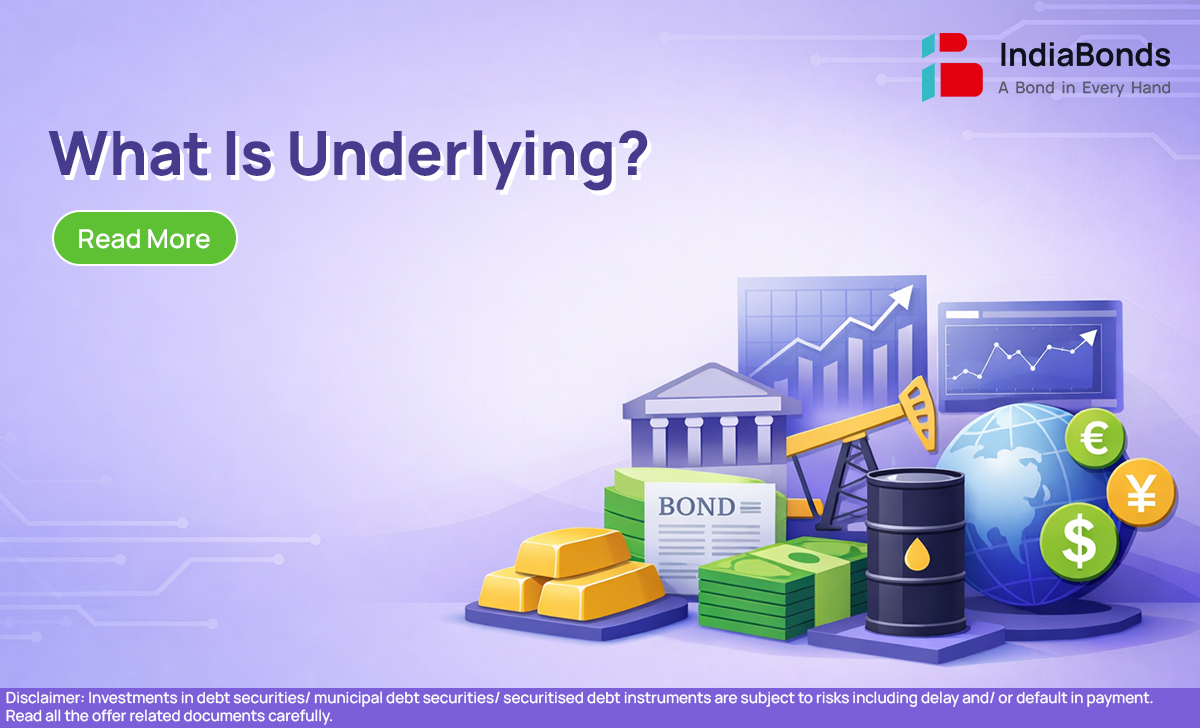
In modern finance, several products look complicated on the surface, but most of them rest on a very simple idea – the Underlying. Whether it is a stock option, a commodity future, or a currency forward, everything finally traces back to one basic asset sitting at the core. Understanding that base is what helps an investor, trader, or risk manager make better sense of market moves.
What Is Underlying?
In finance, the word Underlying refers to the basic asset on which another financial product is built. When someone asks “What is Underlying” in a derivative contract, they are essentially asking, “Which asset decides the value of this contract?” Equity shares, government bonds, gold, crude oil, foreign currencies, stock indices – all of these can act as an Underlying Asset. The contract may change hands many times, but its value always comes from this one source. In simple terms, underlying asset meaning is the real asset that sits beneath a financial contract and drives its price.




How Underlying Assets Influence Markets
The behaviour of Underlying Assets shapes the mood of entire markets. When equity prices rally, the value of equity derivatives usually climbs with them. When interest rates rise, bond prices and the derivatives linked to those bonds move in response. Price changes in Underlyings ripple outwards. They affect portfolio values, margin requirements, hedging strategies and, ultimately, investor confidence. A sharp fall in crude oil, for example, does not only hit oil futures; it can affect airline stocks, currency movements and inflation expectations. Because of this chain reaction, even long-term investors quietly keep an eye on how key Underlying Assets are behaving.
Types of Underlying Assets
There are many types of Underlying Asset, but they usually fall into a few broad buckets:
- Equity shares of listed companies
- Debt instruments such as government securities or corporate bonds
- Commodities like gold, silver, crude oil or agricultural products
- Currencies such as the US dollar, euro or yen
- Market indices that represent a basket of securities
Each category behaves differently and carries its own mix of risk and return.
Exploring the Role of Underlyings in Derivatives
Derivatives cannot exist without Underlyings. A futures or options contract simply sets terms around how two parties will deal with an Underlying Asset at a future date or price.
In an equity option, the share is the Underlying. In a gold future, the metal is the Underlying. In an interest-rate swap, the reference rate (like a government bond yield) is effectively the Underlying. Any gain or loss on the derivative comes from how the Underlying moves.
This link allows investors to hedge risks. An institution holding a bond can use interest-rate futures to reduce the impact of rate changes. A jewellery exporter can use gold futures to protect against swings in gold prices. Without a clear and reliable Underlying, these risk-management tools would not work.
Advantages and Disadvantages of Using Underlying Assets
Working with clearly defined Underlyings has both benefits and limitations.
On the positive side, transparent Underlying Assets make valuation easier. Market participants can see real-time prices, volumes and historical data, which helps in pricing derivatives fairly. They can also use Underlyings for diversification – combining assets such as equities, bonds and commodities to balance risk. These are some of the key Advantages of Underlying Asset in modern finance. However, there are also Disadvantages of Underlying Asset that cannot be ignored. If the Underlying is illiquid or poorly traded, price discovery becomes difficult and spreads widen. In some assets, like certain commodities or exotic indices, data may be limited, making valuation and risk assessment tricky. Extreme events – a policy shock, a default, a natural disaster – can cause sudden and sharp moves in Underlyings and, by extension, in the derivatives linked to them.
Pros and Cons of Underlying
To summarise the Pros of Underlying and Cons of Underlying in a quick view:
Pros
- Provides a clear anchor for valuation
- Enables effective hedging and risk management
- Helps build diversified portfolios across asset classes
Cons
- Illiquid Underlyings can lead to mispricing
- High volatility in the Underlying can magnify derivative risk
Information gaps or poor disclosure around the Underlying increase uncertainty
Underlying Asset – Examples
Real-life Underlying Asset Examples make the idea much easier to see.
- A call option on a listed share uses that share as the Underlying Asset. If the share price rises, the option tends to gain value; if it falls, the option usually loses value.
- A gold futures contract has physical gold as its Underlying. Traders look at global gold prices, demand from jewellers and central banks, and currency movements to judge this Underlying.
- An interest-rate future linked to a government bond uses that bond’s yield as the Underlying measure. When yields move, the price of the future adjusts accordingly.
Each of these contracts is different, but the logic is the same: without the Underlying behaving in a certain way, the contract itself has little meaning.
Potential Challenges with Underlying Assets
Despite their importance, Underlyings bring some practical challenges. Sudden spikes in volatility can trigger margin calls and force investors to exit positions at the wrong time. In a few markets, data on the Underlying Asset may be delayed or incomplete, making risk assessment harder. Legal and operational risks also exist. If contract terms around the Underlying are not clear – for example, how quality or delivery of a commodity will be handled – disputes can arise. For long-term investors, changes in regulation, taxation or accounting rules affecting the Underlying can alter the entire economics of a product.
Different Categories of Underlying Assets
When people speak about Different Categories of Underlying Assets, they are usually referring to how each asset behaves and what role it plays in a portfolio or financial system. Broadly, these categories include:
- Equity Underlyings
- Shares of listed companies.
- Often used in stock futures, options and index derivatives.
- Tend to carry higher risk but also higher growth potential.
- Debt and Fixed-Income Underlyings
- Government securities, treasury bills and corporate bonds.
- Act as Underlyings for interest-rate futures, bond futures and some structured products.
- Generally considered more stable, with predictable coupon or interest cash flows.
- Commodity Underlyings
- Precious metals (gold, silver), energy products (crude oil, natural gas) and agricultural goods.
- Underlie futures and options on commodity exchanges.
- Influenced by global demand–supply, weather patterns and geopolitical events.
- Currency Underlyings
- Pairs like USD/INR or EUR/USD.
- Form the base for currency forwards, futures and options.
- Important for businesses and investors exposed to foreign exchange risk.
- Index Underlyings
- Stock indices or bond indices representing a basket of securities.
- Used for index futures, options and index-linked funds or notes.
- Provide broad market exposure through a single Underlying.
By combining these categories thoughtfully, investors can design portfolios that spread risk across several kinds of Underlying Assets rather than relying on just one segment of the market.
Conclusion
The idea of an Underlying may sound technical at first, but it is simply the foundation on which many financial products rest. Knowing which asset sits underneath a contract – and how that asset behaves – is central to understanding risk, return and valuation. Once this foundation is clear, the world of derivatives and structured products becomes much easier to navigate.
FAQ’s
What is an underlying asset in finance?
An underlying asset in finance is the real asset – such as a share, bond, commodity, currency or index – on which another financial contract is based. The price and payoff of the contract depend on how this asset behaves.
What exactly is an underlying asset?
Put simply, an underlying asset is the base asset that gives value to a derivative or structured product. Without this asset, the contract would have no independent price or purpose.
Is gold an underlying asset?
Yes, gold is a common underlying asset. Gold futures, options or exchange-traded products often use physical gold prices as their Underlying.
What is meant by underlying value?
Underlying value refers to the economic worth of the asset beneath a contract. It reflects fundamentals such as earnings, interest, demand–supply and risk, which ultimately drive prices over time.
What Happens When the Price of an Underlying Asset Increases?
When the price of an underlying asset increases, derivatives linked to it usually react. Call options may gain value, futures might trade higher and portfolios exposed to that Underlying can see mark-to-market profits. The reverse is true when prices fall.
Is a Share an Underlying Asset?
Yes. A listed share is one of the most widely used Underlying Assets for stock futures and options, as well as for many structured notes and equity-linked products.
What Are the Primary Underlying Assets?
The primary underlying assets in most markets are equities, bonds, commodities, currencies and indices. Together, these assets support a wide range of financial products and help investors manage risk and return more efficiently.
Disclaimer : Investments in debt securities/ municipal debt securities/ securitised debt instruments are subject to risks including delay and/ or default in payment. Read all the offer related documents carefully. The inventories offered on the platform offer interest upto 12% returns.
249















CIN: U67100MH2008PTC178990
SEBI Registration No.: INZ000311637
NSE Member ID - Debt Segment: 90316
BSE Member ID - Debt Segment: 6811
Caution : Beware of fraudsters and impersonators misusing the name of IndiaBonds. Always verify communications and transactions through our official website www.indiabonds.com and mobile application only. Click here for Advisory and Safety Tips.