Search


August 2026 Monetary Policy Highlights and Rationale
 3.62K
3.62K
The RBI’s Monetary Policy Committee (MPC) conducted its monetary policy meeting from August 3 to August 5, 2026.
On the basis of an assessment of the evolving macroeconomic situation, the Monetary Policy Committee (MPC) made the following announcements:
- The MPC unanimously decided to maintain the repo rate at 5.25%. Consequently, the SDF rate is maintained at 5.00%.
- The Marginal Standing Facility (MSF) rate and the Bank Rate were also kept unchanged at 5.50%.
- MPC has also decided to keep the stance unchanged at Neutral.
Part A: RBI’s Policy Decision Rationale:
1. Inflation
Headline CPI inflation rose to 4.4% in June 2026, moving above the RBI’s 4% target after remaining below target for sixteen consecutive months. However, Q1 inflation averaged 3.9%, which was 30 bps lower than the RBI’s June projection, reflecting limited pass-through of higher input costs. The increase in inflation was largely driven by food and fuel prices, while underlying demand-driven inflation remained contained. Core inflation (excluding food and fuel) remained unchanged at 3.9%, while core inflation excluding precious metals stayed particularly benign at 2.3-2.5%.
The RBI expects headline inflation to rise further during the coming months and peak during Q3 FY27, primarily because of food and fuel prices before easing thereafter. Although generalized inflationary pressures remain limited, the MPC highlighted risks from El Niño, uneven monsoon, volatile crude oil prices and possible second-round effects from elevated input costs.
The MPC expects CPI outlook to be shaped by several factors such as:
- Persistent volatility in global crude oil prices amid renewed geopolitical tensions in West Asia.
- Deficient and uneven south-west monsoon under El Niño conditions.
- Risk of higher food and fuel prices spilling over into broader inflation.
- Adequate foodgrain stocks and proactive government supply-side measures acting as mitigating factors.
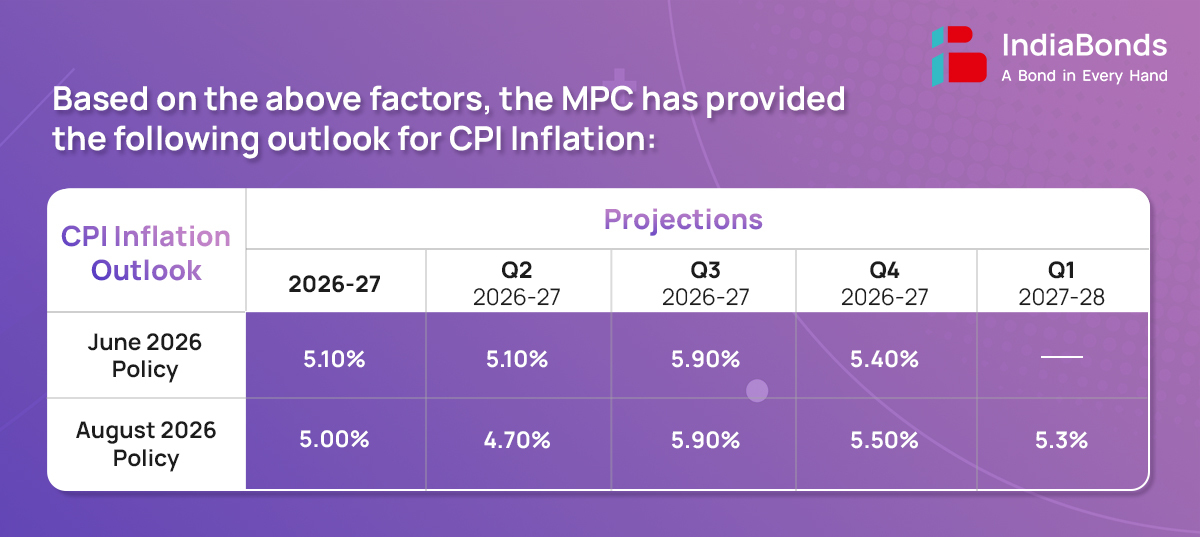
- CPI inflation for FY2026-27 is projected at 5.0%, with Q2 at 4.7%, Q3 at 5.9%, and Q4 at 5.5%.
- Core inflation is projected at 4.3%, while core inflation excluding precious metals is expected to remain lower before gradually converging.
2. Growth
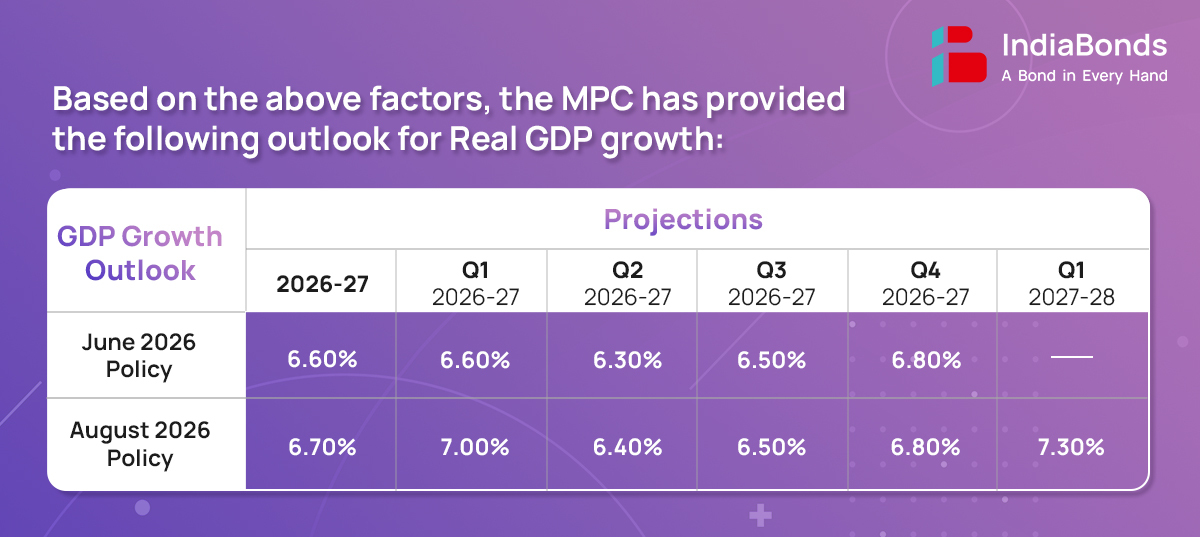
Domestic economic activity remained resilient during Q1 FY27 despite elevated global uncertainty. Manufacturing and services activity continued to expand, supported by healthy corporate earnings, strong domestic demand and robust exports. Investment activity remained supported by government infrastructure spending, high capacity utilisation and strong credit growth.
However, the RBI acknowledged that renewed conflict in West Asia, supply chain uncertainties, elevated energy prices and deficient monsoon conditions pose downside risks to growth. While agriculture faces weather-related challenges, government initiatives on crop diversification, climate-resilient agriculture and water conservation are expected to cushion the impact. Services sector activity, urban consumption and infrastructure investment continue to provide resilience todomestic growth.
3. Liquidity
- System liquidity under the Liquidity Adjustment Facility (LAF) averaged a surplus of around ₹1.0 lakh crore since the June policy.
- Liquidity is expected to improve further through seasonal currency return during the monsoon, drawdown of government cash balances and recent capital inflow measures.
- Weighted Average Call Rate (WACR) remained aligned with the policy corridor, averaging 5.31%.
- Short-term money market rates moderated during July, while G-Sec yields eased across maturities following measures to attract foreign capital into Indian debt markets.
4. Global Economy
The RBI highlighted that the global economic outlook in 2026 so far has been characterised by sharp and frequent market swings, persisting inflation concerns and shifting policy expectations. Relief from the temporary ceasefire in West Asia has quickly dissipated amidst resumption of conflict in July. Persistent inflation has prompted several central banks to raise rates while others remain vigilant.
The US dollar appreciated, supported by elevated yields, a hawkish Federal Reserve tone, and a relatively buoyant US economy riding on AI driven productivity gains. The global equity market remained volatile as investors repriced their exposure to AI-related stocks. Conflict in West Asia, volatile oil prices, sticky inflation expectations, and fragile public finances in systemic economies pose significant downside risks to the outlook.
Part B: Key Statements on Developmental and Regulatory Policies:
1. Draft guidelines for licensing of Urban Co-operative Banks (UCBs)
Following stakeholder consultations on its January 2026 discussion paper, the RBI will shortly issue draft guidelines to resume licensing of Urban Co-operative Banks on an “on-tap” basis, ending a two-decade pause on fresh licences.
2. Review of Concentration Risk Management framework for Rural Co-operative Banks
The RBI will issue draft amendments to comprehensively review the Credit Monitoring Arrangement framework for Rural Co-operative Banks, which has remained largely unchanged since 2008, with the objective of strengthening prudential norms while supporting sector development.
3. Review of Interest Rate Guidelines on Advances
The RBI proposes to harmonise and standardise the regulatory framework governing lending rates including operational aspects of the current framework on MCLR and EBLR across all regulated entities. The proposed framework aims to improve transparency, standardise market practices relating to interest computation and benchmark reset dates, strengthen monetary policy transmission and enhance consumer protection.
The next meeting of the MPC is scheduled for October 5–7, 2026.
3.62K